
Bird strikes and runway debris: extraordinary, but only for the time it actually caused
At a glance
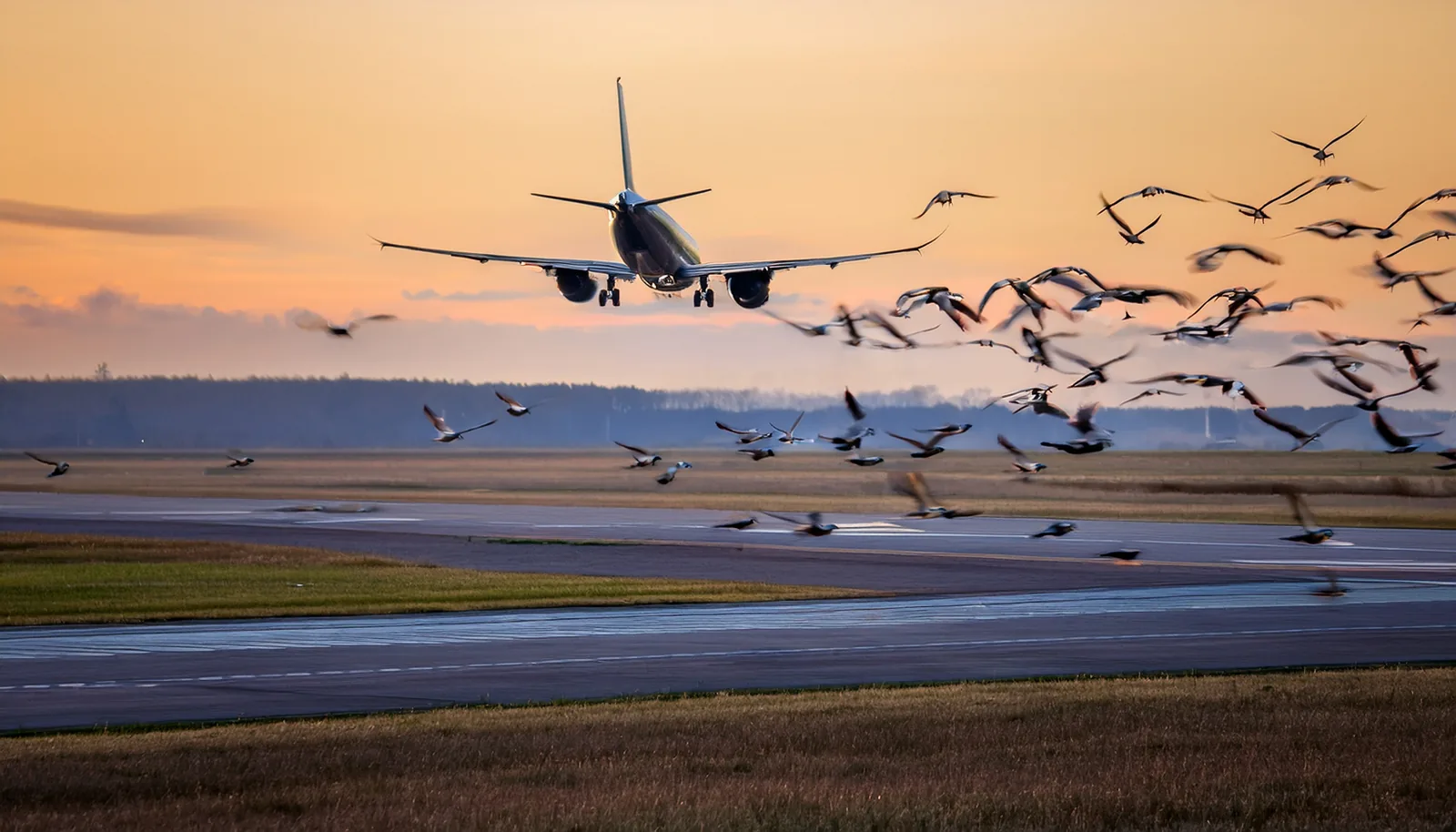
A collision between an aircraft and a bird, and damage to an aircraft tyre caused by a foreign object lying on the runway, are both classified by the Court of Justice of the EU as extraordinary circumstances, but the exception only protects the time the event actually caused. Where a delay has more than one cause, the delay attributable to the extraordinary circumstance is deducted from the total length of the delay, provided the carrier proves that this part could not have been avoided and that it took all reasonable measures to avoid the consequences. When what remains amounts to three hours or more at the final destination you may be covered by the right to compensation. The burden of proving the exception lies with the operating air carrier, not with you.
In this article
Check your compensation
Free preliminary check. You can change your choice later.
Another flight problemWhy birds and debris on the runway count as extraordinary
Where a flight is cancelled, and where it arrives at the final destination at least three hours late, Regulation (EC) No 261/2004 may give a right to financial compensation. The exception is in Article 5(3): the operating air carrier escapes paying only if it can prove that the disruption was caused by extraordinary circumstances which could not have been avoided even if all reasonable measures had been taken. The Court of Justice applies two conditions, both of which must be met: the event must not be inherent in the normal exercise of the carrier's activity, and it must be outside that carrier's actual control.
The bird strike was examined in Case C-315/15, Pešková and Peška v Travel Service, where the Court's Third Chamber held on 4 May 2017 that a collision between an aircraft and a bird is classified under the concept of extraordinary circumstances. The background was a flight from Burgas to Ostrava carried out on 10 August 2013 with a delay in arrival of five hours and twenty minutes.
Debris and spillage on the runway have also been examined by the Court. In Case C-501/17, Germanwings v Pauels, the Court held on 4 April 2019 that damage to an aircraft tyre caused by a foreign object lying on an airport runway falls within the concept of extraordinary circumstances: damage that is solely the result of such an object, which the carrier must prove, is not inherent in the normal exercise of the air carrier's activity, and since the carrier is not responsible for clearing the runway, the circumstance is outside its actual control. In that case a screw was found in a tyre of the aircraft due to operate the flight from Dublin to Düsseldorf on 28 August 2015. In Case C-159/18, Moens v Ryanair, the Court reached the same conclusion on 26 June 2019 for petrol on the runway which led to the runway being closed, but the ruling rests on an express condition: the petrol did not originate from an aircraft of the carrier that operated that flight.
The deduction: only the time the event actually caused
The fact that an event is extraordinary does not mean the whole delay is protected. The Pešková judgment contains a rule that is easy to miss: where a delay has more than one cause, the part attributable to the extraordinary circumstance must be deducted from the total length of the delay in arrival, and only then is it assessed whether what remains reaches three hours at the final destination. The deduction requires the carrier to prove that this part of the delay was due to an extraordinary circumstance which could not have been avoided, and that it took all reasonable measures to avoid the consequences. If it has not done so, that time counts too. The three-hour threshold itself does not come from these judgments but from Joined Cases C-402/07 and C-432/07, Sturgeon and Others, where the Court held on 19 November 2009 that a loss of time equal to or in excess of three hours on arrival at the final destination may give the same right to compensation as a cancelled flight.
The same judgment also sets a limit on what the carrier may attribute to the bird strike. Where an expert authorised under the applicable rules has already checked the aircraft after the collision, and the carrier then has fresh safety checks carried out by an expert of its own choice, the Court holds that the second check cannot be treated as a measure appropriate to the situation; the delay it causes is not due to extraordinary circumstances. The Court also ruled on the second limb of Article 5(3): the reasonable measures include control measures preventing the presence of birds, provided that the carrier can actually take them, that they do not require it to make intolerable sacrifices in the light of the capacities of its undertaking, and that the carrier shows that those measures were actually taken as regards the flight affected by the collision. Only measures that are actually the carrier's own responsibility count, not those for which, for example, the airport or air traffic control is responsible. In Case C-159/18, by contrast, the Court held that a runway closure of that kind had to be regarded as a circumstance which could not have been avoided even if all reasonable measures had been taken.
Quick guide: birds, debris and petrol on the runway
- Collision with a bird: an extraordinary circumstance according to the Court of Justice of the EU (C-315/15).
- Tyre damage caused by a foreign object lying on an airport runway: an extraordinary circumstance (C-501/17).
- Petrol on the runway which leads to the runway being closed: an extraordinary circumstance; the ruling concerns petrol that does not originate from an aircraft of the operating air carrier itself (C-159/18).
- The part of the delay attributable to the extraordinary circumstance is deducted from the total length of the delay if the carrier proves that it could not have been avoided and that it took all reasonable measures to avoid the consequences; what remains is assessed against the three-hour threshold (C-315/15).
- If the carrier has an expert of its own choice repeat the check after an authorised expert has already checked the aircraft, the resulting delay is not due to extraordinary circumstances (C-315/15).
- Even where the circumstance is extraordinary, the carrier must prove that it deployed all its resources in staff, equipment and financial means at its disposal to avoid a long delay (C-501/17).
- The burden of proving the exception in Article 5(3) lies with the operating air carrier.
- Cancelled flight: a choice between re-routing and reimbursement, plus meals, refreshments and, where needed, hotel accommodation, whatever the cause (Articles 5, 8 and 9; C-12/11).
- Delayed flight: meals and refreshments once the delay is expected to reach two, three or four hours depending on the distance, hotel accommodation if departure is put back to the next day, and a right to reimbursement once the delay reaches five hours, again whatever the cause (Article 6).
Example: the bird accounted for part of the delay
Your aircraft is struck by a bird on approach to an intermediate stop. The aircraft has to be checked, and you reach your final destination six hours late. The collision is in itself an extraordinary circumstance. But the exception only covers the time attributable to the collision and the necessary check. Time caused by something else (the carrier having an expert of its own choice repeat the check after an authorised expert had already checked the aircraft, or a cause that is inherent in the normal exercise of its activity) cannot, under the Pešková judgment, be attributed to the event. If three hours or more remain once the bird-related time has been deducted, you may be covered by the right to compensation. How the hours are apportioned is a question of evidence, and it is for the carrier to prove its case.
A rejection that says only "bird strike" is not the whole answer
Article 5(3) requires two things of the operating air carrier: that it proves the event was extraordinary, and that the delay could not have been avoided even if all reasonable measures had been taken. A standard reply containing the words bird strike or debris on the runway says nothing about the second limb, and nothing about how many of the hours the event actually caused.
Ask the carrier to set out how long the event and the necessary check took, who carried out the check, what measures against birds were taken for your flight, and what accounts for the rest of the time. If petrol on the runway was the reason, its origin is relevant: the ruling in Case C-159/18 expressly concerns petrol that did not originate from an aircraft of the operating air carrier, so if the spillage came from the carrier's own aircraft that judgment cannot simply be relied on as support. If the carrier has not set this out, it has not yet shown what Article 5(3) requires.
What it could amount to
If the exception does not hold, compensation is calculated under Article 7(1) according to the distance of the flight, not according to what the ticket cost. In some cases the amount may be reduced by 50% under Article 7(2).
| Flight distance | Compensation level |
|---|---|
| Flights up to 1,500 km | €250 |
| 1,500–3,500 km (and longer intra-EU flights) | €400 |
| Flights over 3,500 km | €600 |
The amounts apply per passenger.
The airline may halve the amount if it offers rerouting that arrives no more than 2 hours (up to 1,500 km), 3 hours (1,500–3,500 km and longer intra-EU flights) or 4 hours (other flights over 3,500 km) after the original arrival time (Article 7(2)). For a delay on a flight over 3,500 km to or from a country outside the EU, the amount may also be halved if you arrive at least three but less than four hours late (Court of Justice, Sturgeon and Others, paragraph 63).
What to do after a bird strike or a runway incident
Note down the times
Note the scheduled and the actual arrival time at your final destination. The deduction is built on times, so the more precisely you can document the sequence of events, the harder it becomes for the carrier to blame the whole delay on the event.
Keep the carrier's own explanation
Save emails, text messages and push notifications stating the reason, and take screenshots of the departure boards. The wording is the starting point when you later question how much of the delay the event caused.
Accept what you can get at the airport
If the flight is cancelled you choose between re-routing and reimbursement. Meals, refreshments and, where needed, hotel accommodation apply whatever the cause: for a delay, from two, three or four hours depending on the distance. If the carrier does not arrange them, expenses that were necessary, appropriate and reasonable may be reimbursed afterwards. Keep the receipts.
Ask for written reasons
Ask expressly how many of the hours are attributed to the event and what measures the carrier took. A refusal without that breakdown need not be the last word.
Common questions about bird strikes and objects on the runway
Not necessarily. The Court of Justice of the EU has classified bird strikes as extraordinary circumstances, but the carrier must also prove that it took all reasonable measures, and only the time attributable to the collision is covered by the exception. If three hours or more remain to the final destination once that time has been deducted, you may be covered by the right to compensation.
For petrol it does. The Court's conclusion in Case C-159/18 expressly concerns petrol that did not originate from an aircraft of the carrier that operated the flight. If the spillage came from the carrier's own aircraft, the situation falls outside what the Court examined, and the conclusion in that judgment cannot then simply be relied on to support a refusal.
For foreign objects on the runway, the reasoning in Case C-501/17 had two parts: tyre damage that is solely the result of such an object is not inherent in the normal exercise of the air carrier's activity, and since the carrier is not responsible for clearing the runway, the circumstance is outside its actual control. It is for the carrier to prove that the damage was caused solely by the object. At the same time the Court was clear that the carrier must still prove that it deployed all its resources at its disposal to avoid a long delay.
The exception in Article 5(3) is assessed in the same way where a flight is cancelled. The difference is that with a cancelled flight you may in addition choose between reimbursement and re-routing under Article 8, and that choice applies whether or not the cause was extraordinary.
Regulation (EU) 2026/2202 amends Regulation 261/2004 but only applies from 23 October 2027. Until then, what is described in this article applies. The new rules add a non-exhaustive list of circumstances to be considered extraordinary. It includes damage to the aircraft caused by animals or by foreign objects, and contamination of the runway that does not originate from the air carrier, in both cases where this is incompatible with the safe operation of the flight. The carrier will still have to prove that the disruption could not have been avoided even if all reasonable measures had been taken.
Check your compensation
Free preliminary check. You can change your choice later.
Another flight problemShow all 7 sources
Every factual statement in this article rests on one of the sources below: EU regulations, judgments of the EU Court of Justice and the authorities' own pages.
Sources
- Judgment in Case C-315/15, Marcela Pešková and Jiří Peška v Travel Service a.s. (Third Chamber, 4 May 2017) · EUR-Lex / Court of Justice of the EU · Case law · retrieved 2026-10-01
- Judgment in Case C-501/17, Germanwings GmbH v Wolfgang Pauels (Third Chamber, 4 April 2019) · EUR-Lex / Court of Justice of the EU · Case law · retrieved 2026-10-01
- Judgment in Case C-159/18, André Moens v Ryanair Ltd (Fourth Chamber, 26 June 2019) · EUR-Lex / Court of Justice of the EU · Case law · retrieved 2026-10-01
- Regulation (EC) No 261/2004 of the European Parliament and of the Council, Articles 5, 6, 7, 8 and 9 and recital 14 · EUR-Lex · Regulation · retrieved 2026-10-01
- Judgment in Joined Cases C-402/07 and C-432/07, Sturgeon and Others v Condor Flugdienst and Böck and Lepuschitz v Air France (19 November 2009) · EUR-Lex / Court of Justice of the EU · Case law · retrieved 2026-10-01
- Judgment in Case C-12/11, Denise McDonagh v Ryanair Ltd (Third Chamber, 31 January 2013) · EUR-Lex / Court of Justice of the EU · Case law · retrieved 2026-10-06
- Regulation (EU) 2026/2202 of the European Parliament and of the Council of 16 September 2026 amending Regulation (EC) No 261/2004 and Council Regulation (EC) No 2027/97 (OJ L, 2.10.2026) · EUR-Lex (Official Journal of the European Union) · Regulation · retrieved 2026-10-06