
The airline says ‘extraordinary circumstances’: what does the reply mean?
At a glance
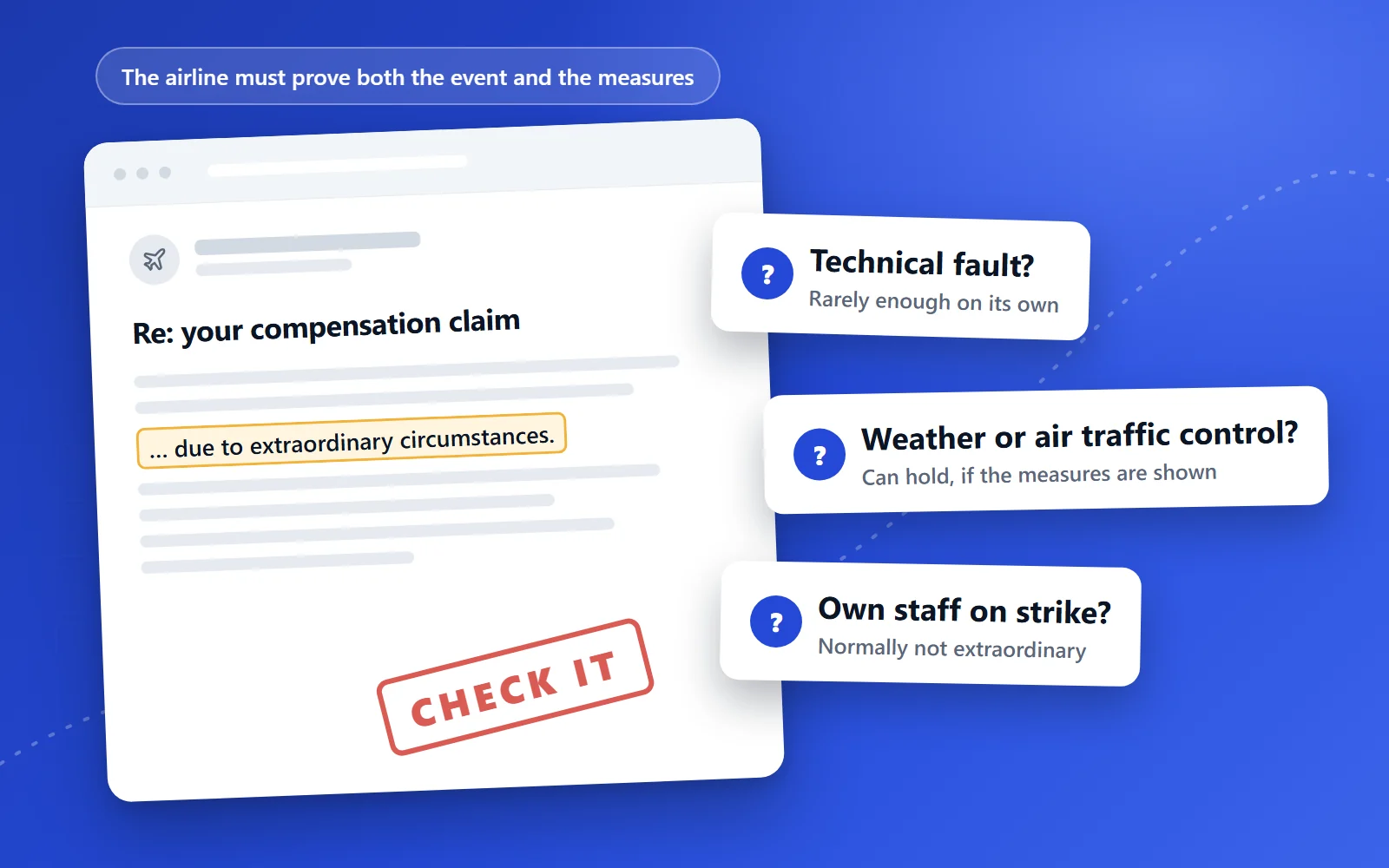
‘Extraordinary circumstances’ is a claim, not a ruling. It is for the airline to prove both that such a circumstance existed and that the consequences could not have been avoided by all reasonable measures (Article 5(3) of Regulation 261/2004). What holds depends on what the airline actually writes.
2 conditions
the airline must prove: an extraordinary circumstance and all reasonable measures
The airline
bears the burden of proof, and the exemption is read strictly (Art. 5(3))
€250–600
compensation per passenger under Article 7, by flight distance
In this article
Check your compensation
Free preliminary check. You can change your choice later.
Another flight problemWhat the airline must prove, and what is not enough
The wider concept is covered in the EU261 guide. Here the focus is the reply you have received.
Two conditions, both on the airline. It must show that the event, by its nature or origin, lies outside its normal activity and actual control (C-549/07, operative part point 1), and that the consequences still could not have been avoided by measures adapted to the situation (C-549/07, paragraphs 40 and 41). The exemption is interpreted strictly (C-549/07, paragraphs 17 and 20).
A phrase is not proof. ‘Technical fault’ or ‘operational reasons’ names a category. It says nothing about which event occurred, how it affected your flight or what the airline did. Read more about how a refusal is tested and what all reasonable measures means.
| The airline writes | Can hold when | Rarely holds when |
|---|---|---|
| Technical fault | The fault originates outside the airline, for example a general fault in the airport's fuel system where the airport is responsible for it (C-308/21). | It is an ordinary fault on the aircraft, even if unexpected and not found at maintenance (C-549/07, C-257/14). |
| Weather | The weather made the flight impossible (recital 14) and the airline shows how it hit your flight and that the consequences could not be avoided. | Weather is mentioned only in general terms. Weather is not in itself an extraordinary circumstance (C-549/07, paragraphs 21 and 22). |
| Air traffic control restrictions | An air traffic management decision concerned your particular aircraft that day (recital 15). | The airline cannot point to a decision that concerned your aircraft, or does not show which part of the delay it accounts for (C-315/15, paragraphs 50–52). |
| Strike | Air traffic controllers or airport staff are striking (C-28/20, paragraph 42). | The airline's own staff are striking. That is an internal event (C-28/20, paragraph 44). |
| Operational reasons | The airline can name a concrete external event behind the label. | Nothing more is said. A phrase that general does not show which event occurred or that it was outside the airline's control, which the airline must show (Art. 5(3)). |
| Crew shortage or sick crew | The shortage is at another party, such as airport baggage handlers, and the airline shows its measures (C-405/23). | It concerns the airline's own crew. Illness and rostering are part of normal activity (C-156/22). |
| Safety reasons | There is a concrete event, for example a bird strike (C-315/15). | The airline had a safety check repeated that an authorised expert had already carried out (C-315/15), or gives only ‘safety reasons’ with no concrete event. |
| Knock-on effect from an earlier flight | The same aircraft was affected earlier and there is a direct causal link to your delay (C-74/19). | The airline refers only to ‘earlier in the day’ or to a different aircraft. |
| Airport or airspace closed | The closure was caused by an external event and the airline had planned a reasonable time buffer (C-294/10). | The closure did not affect your flight, or the airline does not show what measures it took. |
Even a genuine extraordinary circumstance is only half the proof
That the event counts as extraordinary does not settle the matter. The airline must then show that, even with all available staff, equipment and finances, it clearly could not have avoided the consequence without intolerable sacrifices (C-549/07, paragraph 41). And parts of a delay the airline could have avoided are not deducted (C-315/15, paragraphs 50–52).
The phrasings one by one
‘Technical fault.’ A common reason, and one that rarely suffices on its own. A technical problem is not extraordinary unless it stems from an event outside the airline's activity, and following minimum maintenance rules is not enough (C-549/07). See technical faults and extraordinary circumstances.
‘Weather’ and ‘air traffic control’. Both appear in the Regulation's recitals, but as examples. The airline must show the link to your flight. An air traffic restriction can cause both a delay and a knock-on delay, and the airline must show which part it accounts for.
‘Strike.’ Whose strike it is matters most. Read strikes and flight compensation.
‘Operational reasons’ and ‘crew shortage.’ Can be phrases that do not say which event occurred. Ask whose staff and which event, see crew illness and staff shortages.
‘Earlier flight’ and ‘airport closed.’ An earlier flight can count, but only with a direct causal link and the same aircraft, see disruption on an earlier flight. For closures, see airport and airspace closures.
Example: three words that prove nothing
You land four hours late. The reply says the delay was caused by ‘operational reasons beyond our control, which constitute extraordinary circumstances’. No event, no link to your flight, no measures. Measured against the conditions in Article 5(3), the airline has shown neither requirement. That does not mean the claim succeeds, but it does mean the reply does not settle the matter.
Why it pays to let Airlate assess and pursue the claim
- We know the rules. We read the airline's wording against the Regulation and Court of Justice case law, so you do not have to work out whether ‘technical fault’ or ‘operational reasons’ really holds.
- A correct assessment of each case. The same words can mean different things. We assess your flight on its own, free of charge.
- We handle the hassle and the correspondence. Once you have submitted the claim and accepted the terms, Airlate deals with the airline, manually and under your authorisation.
- We do not give up at the first hurdle. If we assess that the claim has reasonable prospects, we can take it further, where needed through an enforcement body, alternative dispute resolution or court. No outcome can be promised, and Airlate decides which measures are appropriate. If we obtain no compensation for you, we charge no service fee, under the Fee Policy.
Next step
Keep the airline's reply in its original form, with sender and date. You can go on to a dispute body or court yourself, but the route we recommend is to have a representative test the reply against the rules. If the airline does not reply at all, read what to do when the airline does not respond.
What you get to keep
Every company that pursues claims keeps part of the compensation. This is how much of €600 is left for you, according to the companies' own price lists.
What you keep of €600
Of the five companies we compared, you keep the most with Airlate, both when the claim is settled directly and when it goes on to legal process.
| Company | Without legal process | With legal process |
|---|---|---|
| Airlate | €450 | €360 |
| Flyghjälp (Flightright) | €420 | €330 |
| AirAdvisor | €420 | €300 |
| AirHelp | €390 | €300 |
| Skycop | €336 | €300 |
Want to know how it works?
We assess free of charge whether your flight may be covered. If you submit a claim and accept the terms, Airlate handles the claim manually.
Common questions
No. It is a claim the airline must prove, and the exemption is read strictly (Art. 5(3), C-549/07). Whether it succeeds depends on which event it was and what the airline did.
Extraordinary circumstances can release the airline from compensation, but not from the obligation to provide care under Articles 5(1)(b) and 9 (C-12/11, McDonagh v Ryanair).
The part due to an extraordinary circumstance is deducted, but only if the airline shows it could not have been avoided. If three hours or more remain on arrival, compensation may be relevant (C-315/15).
Check your compensation
Free preliminary check. You can change your choice later.
Another flight problemShow all 11 sources
Every factual statement in this article rests on one of the sources below: EU regulations, judgments of the EU Court of Justice and the authorities' own pages.
Sources
- Regulation (EC) No 261/2004 of the European Parliament and of the Council of 11 February 2004 (recitals 14 and 15 and Articles 5(1)(b), 5(1)(c), 5(3), 7(1) and 9) · EUR-Lex · Regulation · retrieved 2026-10-01
- Judgment in Case C-549/07, Friederike Wallentin-Hermann v Alitalia – Linee Aeree Italiane SpA (Fourth Chamber, 22 December 2008) · EUR-Lex / Court of Justice of the EU · Case law · retrieved 2026-10-01
- Judgment in Case C-257/14, Corina van der Lans v Koninklijke Luchtvaart Maatschappij NV (Ninth Chamber, 17 September 2015) · EUR-Lex / Court of Justice of the EU · Case law · retrieved 2026-10-01
- Judgment in Case C-315/15, Marcela Pešková and Jiří Peška v Travel Service a.s. (Third Chamber, 4 May 2017) · EUR-Lex / Court of Justice of the EU · Case law · retrieved 2026-10-01
- Judgment in Case C-28/20, Airhelp Ltd v Scandinavian Airlines System Denmark – Norway – Sweden (Grand Chamber, 23 March 2021) · EUR-Lex / Court of Justice of the EU · Case law · retrieved 2026-07-03
- Judgment in Case C-74/19, LE v Transportes Aéreos Portugueses SA (Fourth Chamber, 11 June 2020) · EUR-Lex / Court of Justice of the EU · Case law · retrieved 2026-10-01
- Judgment in Joined Cases C-156/22 to C-158/22, TAP Portugal v flightright GmbH and Others (Third Chamber, 11 May 2023) · EUR-Lex / Court of Justice of the EU · Case law · retrieved 2026-10-01
- Judgment in Case C-405/23, Touristic Aviation Services Ltd v Flightright GmbH (Ninth Chamber, 16 May 2024) · EUR-Lex / Court of Justice of the EU · Case law · retrieved 2026-10-01
- Judgment in Case C-308/21, KU, OP and GC v SATA International – Azores Airlines SA (Eighth Chamber, 7 July 2022) · EUR-Lex / Court of Justice of the EU · Case law · retrieved 2026-10-01
- Judgment in Case C-294/10, Andrejs Eglītis and Edvards Ratnieks v Latvijas Republikas Ekonomikas ministrija (Third Chamber, 12 May 2011) · EUR-Lex / Court of Justice of the EU · Case law · retrieved 2026-10-01
- Judgment in Case C-12/11, Denise McDonagh v Ryanair Ltd (Third Chamber, 31 January 2013) · EUR-Lex / Court of Justice of the EU · Case law · retrieved 2026-10-06
Related guides
- EU261: the regulation explained
- The airline said no: how to dispute a refusal
- Technical faults: when does the airline's exception hold?
- "All reasonable measures": the requirement that can defeat a refusal
- Strikes and flight compensation: when can you claim?
- "It happened on an earlier flight": when can the airline blame the morning's disruption?
- Crew illness or death, and how airport staff shortages differ
- Closed airport and closed airspace: ash clouds, power cuts, refuelling systems, and drones