
The airline said no: how to dispute a refusal
At a glance
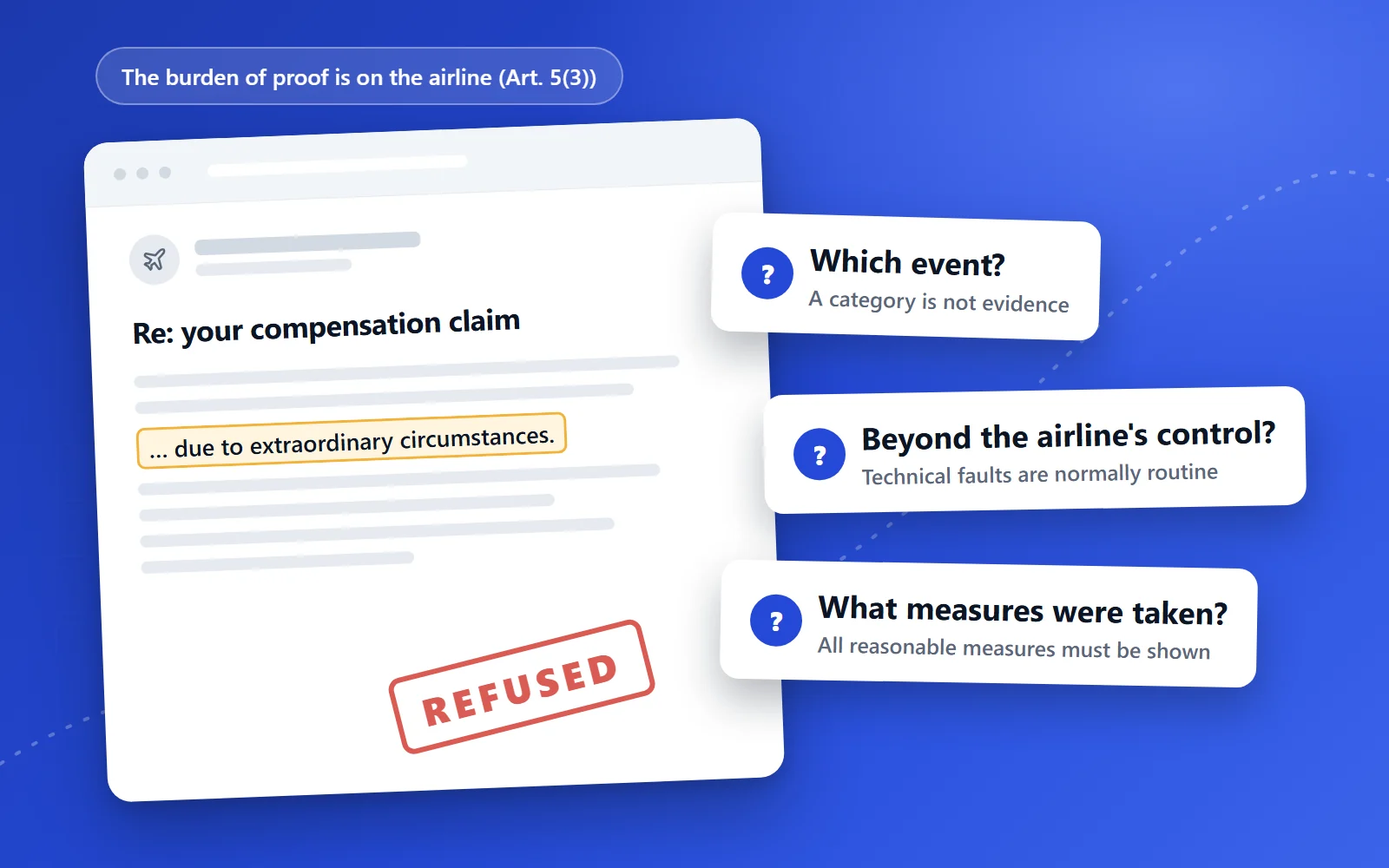
No, a refusal is not the last word. It is the airline that must prove the disruption was caused by extraordinary circumstances which could not have been avoided even if all reasonable measures had been taken (Article 5(3) of EU Regulation 261/2004). A standard sentence about a technical fault or the weather names a cause but proves nothing. Ask the airline for its evidence in writing, and have the claim taken further if the answer does not hold.
The airline
bears the burden of proving extraordinary circumstances (Art. 5(3))
€250–600
compensation per passenger under Article 7, by flight distance
1 year
to refer a dispute to ARN in Sweden after first complaining
In this article
Check your compensation
Free preliminary check. You can change your choice later.
Another flight problemWhat the airline must be able to prove
The main rule. If your flight is cancelled, you may be entitled to compensation under Article 7 (Article 5(1)(c)). The EU Court of Justice has held that the same right may apply if you reach your final destination three hours or more late (Joined Cases C-402/07 and C-432/07, Sturgeon and Others).
The exception. The airline only avoids paying if it can prove that the disruption was caused by extraordinary circumstances which could not have been avoided even if all reasonable measures had been taken (Article 5(3)). The exception covers both cancellations and arrival delays of three hours or more (C-315/15, paragraphs 20 and 27). Because it is an exception to a rule that protects consumers, it must be interpreted strictly (C-549/07, Wallentin-Hermann, paragraphs 17 and 20).
Two conditions, not one. The airline must prove both: that there was an extraordinary circumstance, and that the consequences could not have been avoided by measures adapted to the situation (C-549/07, paragraph 40). The second condition is demanding. The airline must show that it could not have avoided the cancellation or delay even using all the staff, equipment and financial means at its disposal, without making intolerable sacrifices in the light of its capacity at the relevant time (C-549/07, paragraph 41, and C-315/15, paragraph 29). See also what all reasonable measures means.
The Regulation does not currently prescribe any particular form for a letter of refusal. But a refusal that names only a category says nothing about either condition. That is why you can ask for four things: the specific event, why it lay outside the airline's normal activity and actual control, how it affected your flight, and what measures the airline took.
Test the refusal against five questions
- What reason does the airline give? If it says the flight is not covered by the Regulation, or that the arrival delay was under three hours, the matter turns on rules other than the Article 5(3) exception.
- Is a specific event named, or only a category such as a technical fault, the weather or an operational disruption?
- Is it clear how the event affected your flight, and not merely traffic in general that day?
- Does the airline set out the measures it took to avoid or limit the consequences?
- Does the airline say you were told in time? Then it is for the airline to prove whether and when you were informed (Article 5(4)).
A technical fault is rarely enough on its own
A technical problem that leads to a cancellation is not an extraordinary circumstance unless it stems from events which, by their nature or origin, are not inherent in the airline's normal activity and are beyond its actual control (C-549/07, Wallentin-Hermann). How often an airline has technical problems does not decide the question, and complying with the minimum maintenance rules is not in itself enough to show that all reasonable measures were taken.
In C-257/14, van der Lans v KLM, the technical problem occurred unexpectedly, was not caused by poor maintenance and was not detected during routine maintenance. That was not an extraordinary circumstance either. Unexpected is not the same as extraordinary. Read more in technical faults and extraordinary circumstances.
When the cause really does lie outside the airline
Sometimes it does. A collision between an aircraft and a bird is an extraordinary circumstance (C-315/15, Pešková and Peška v Travel Service). But the judgment does not stop there, and the second half is the useful part for you: even then, the reasonable measures must be proven. If the airline could take measures to prevent the presence of birds without intolerable sacrifices, it is for the airline to show that it actually took them for the flight in question (operative part, point 3, and paragraphs 44 to 47). See also bird strikes and runway debris.
In the same case, the Court held that a disruption is not caused by extraordinary circumstances where the airline, after an authorised expert had already carried out the safety check required after a bird strike, chose to have its own expert repeat it. The Court also dealt with the mixed case. If a delay of three hours or more is only partly due to an extraordinary circumstance, that part is deducted. But only if the airline took the reasonable measures required, and it is for the airline to prove that this part of the delay could not have been avoided (paragraphs 50 and 52).
Example: the refusal that names only a category
You land four hours and twenty minutes late. The airline replies that the delay was caused by an unexpected technical fault and that this is an extraordinary circumstance. Nothing about what the fault was, why it was beyond the airline's control or what the airline did. Measured against the case law of the EU Court of Justice, that is a weak refusal: technical faults are normally part of the business, and the answer addresses neither condition. If no substantiated answer follows, the claim can be taken further.
How to dispute the refusal
Keep the refusal in its original form
Keep the email with its sender and date. The exact wording is what you are answering, and if the airline later gives a different explanation you can point to the difference. Keep your booking confirmation and boarding pass too.
Ask for the evidence in writing
Ask for the specific event, why it lay outside the airline's normal activity and control, how it affected your flight and what measures were taken. Refer to Article 5(3): it is for the airline to prove that the exception applies.
Test the notification objection
If the airline claims you were told in good time before departure, it is for the airline to prove whether and when that happened (Article 5(4)).
Do not quietly accept a lower sum
In the event of cancellation, denied boarding or a delay of at least two hours, the airline must give you written notice of the rules on compensation and assistance (Article 14(2)). Obligations under the Regulation may not be limited or waived, for example by a clause in the contract of carriage (Article 15(1)). If you accepted lower compensation because you were not properly informed of your rights, you can still go to a court or competent body to obtain the rest (Article 15(2)).
Have the claim assessed
If the reasons do not hold, the claim can be assessed by an alternative dispute resolution body or by a court. In Sweden, the National Board for Consumer Disputes (Allmänna reklamationsnämnden, ARN) can examine whether you are entitled to compensation where the airline has said no. The complaint must reach ARN within one year of first complaining to the airline, and it costs SEK 150. ARN's decision is a recommendation, and anyone who is not satisfied can go to court. You can also complain to the enforcement body under Article 16, in Sweden Konsumentverket (the Swedish Consumer Agency). That body is not required to compel the airline to pay your claim (Joined Cases C-145/15 and C-146/15, Ruijssenaars and Others), Konsumentverket does not assess individual cases, and the corresponding bodies in other countries work in different ways. If the airline does not reply at all, read what to do when the airline does not respond.
What is at stake
If the airline's objection fails, compensation under Article 7 is calculated by the distance of the flight, not by what the ticket cost. See all compensation amounts.
| Flight distance | Compensation level |
|---|---|
| Flights up to 1,500 km | €250 |
| 1,500–3,500 km (and longer intra-EU flights) | €400 |
| Flights over 3,500 km | €600 |
The amounts apply per passenger.
The airline may halve the amount if it offers rerouting that arrives no more than 2 hours (up to 1,500 km), 3 hours (1,500–3,500 km and longer intra-EU flights) or 4 hours (other flights over 3,500 km) after the original arrival time (Article 7(2)). For a delay on a flight over 3,500 km to or from a country outside the EU, the amount may also be halved if you arrive at least three but less than four hours late (Court of Justice, Sturgeon and Others, paragraph 63).
What you get to keep
Every company that pursues claims keeps part of the compensation. This is how much of €600 is left for you, according to the companies' own price lists.
What you keep of €600
Of the five companies we compared, you keep the most with Airlate, both when the claim is settled directly and when it goes on to legal process.
| Company | Without legal process | With legal process |
|---|---|---|
| Airlate | €450 | €360 |
| Flyghjälp (Flightright) | €420 | €330 |
| AirAdvisor | €420 | €300 |
| AirHelp | €390 | €300 |
| Skycop | €336 | €300 |
Common questions about refusals and disputing them
No. Calling the decision final does not change the burden of proof. Article 5(3) is an exception to the compensation rule in Article 5(1)(c), and the EU Court of Justice has held that such an exception must be interpreted strictly. If the reasons do not hold, you can refer the dispute to the National Board for Consumer Disputes (ARN) in Sweden or go to court. Konsumentverket, the enforcement body under Article 16 in Sweden, receives complaints but does not assess your individual claim.
Not automatically. Recital 14 of the Regulation lists meteorological conditions incompatible with the flight among the events that may give rise to extraordinary circumstances. But the EU Court of Justice has held that such events are not in themselves extraordinary circumstances (C-549/07, paragraphs 21 and 22). Even where the cause lies outside the airline, it must prove that the consequences could not have been avoided by measures adapted to the situation (C-549/07, paragraph 40). The bird strike case is a comparison: there, if the airline could take preventive measures without intolerable sacrifices, it had to show they were actually taken for that flight.
No reply does not improve the airline's position on proof, because it is the airline that must show the Article 5(3) exception applies. Keep a record of what you asked for and when, and have the claim taken further. Nobody can promise in advance how long an assessment will take or how it will end.
Yes, but only from 23 October 2027, when Regulation (EU) 2026/2202 starts to apply. Until then, the rules in this article apply. After that, a compensation request must be made within nine months of the departure date, and the airline must, within 30 calendar days, either pay or explain why it is not paying. If it relies on an extraordinary circumstance, it must say which one and give a clear and substantiated explanation. Read more about the new EU rules.
Check your compensation
Free preliminary check. You can change your choice later.
Another flight problemShow all 9 sources
Every factual statement in this article rests on one of the sources below: EU regulations, judgments of the EU Court of Justice and the authorities' own pages.
Sources
- Regulation (EC) No 261/2004 of the European Parliament and of the Council of 11 February 2004 (recital 14 and Articles 3, 5(1)(c), 5(3), 5(4), 7(1), 7(2), 14(2), 15 and 16) · EUR-Lex · Regulation · retrieved 2026-10-01
- Judgment in Case C-549/07, Friederike Wallentin-Hermann v Alitalia – Linee Aeree Italiane SpA (Fourth Chamber, 22 December 2008) · EUR-Lex / Court of Justice of the EU · Case law · retrieved 2026-10-01
- Judgment in Case C-257/14, Corina van der Lans v Koninklijke Luchtvaart Maatschappij NV (Ninth Chamber, 17 September 2015) · EUR-Lex / Court of Justice of the EU · Case law · retrieved 2026-10-01
- Judgment in Case C-315/15, Marcela Pešková and Jiří Peška v Travel Service a.s. (Third Chamber, 4 May 2017) · EUR-Lex / Court of Justice of the EU · Case law · retrieved 2026-10-01
- Judgment in Joined Cases C-402/07 and C-432/07, Christopher Sturgeon and Others v Condor Flugdienst GmbH and Stefan Böck and Cornelia Lepuschitz v Air France SA (Fourth Chamber, 19 November 2009) · EUR-Lex / Court of Justice of the EU · Case law · retrieved 2026-10-06
- Judgment in Joined Cases C-145/15 and C-146/15, K. Ruijssenaars, A. Jansen and J.H. Dees-Erf v Staatssecretaris van Infrastructuur en Milieu (Eighth Chamber, 17 March 2016) · EUR-Lex / Court of Justice of the EU · Case law · retrieved 2026-10-06
- Konsument – how to refer a dispute to ARN (Swedish-language page) · Swedish National Board for Consumer Disputes (Allmänna reklamationsnämnden, ARN) · Authority · retrieved 2026-10-06
- Försenat flyg (Delayed flights, Swedish-language page) · Konsumentverket (Swedish Consumer Agency) · Authority · retrieved 2026-10-06
- Regulation (EU) 2026/2202 of the European Parliament and of the Council of 16 September 2026 amending Regulation (EC) No 261/2004 and Council Regulation (EC) No 2027/97 (OJ L, 2.10.2026) · EUR-Lex (Official Journal of the European Union) · Regulation · retrieved 2026-10-06