
The airline says ‘air traffic control restrictions’: what does that mean?
At a glance
Air traffic control can be an extraordinary circumstance, but the airline must show which decision affected your flight and that the delay could not be avoided by reasonable measures. A general ‘ATC restrictions’ is a statement, not evidence.
The airline proves
that air traffic control caused the delay and that it could not be avoided by reasonable measures (Art. 5(3), C-549/07, paras 40 and 41)
Only that part
of the delay which is due to the extraordinary circumstance may be deducted (C-315/15, paras 50-52)
External
is an air traffic controllers' strike, unlike a strike by the airline's own staff (C-28/20, paras 42-44)
In this article
Check your compensation
Free preliminary check. You can change your choice later.
Another flight problemWhat the rules say about air traffic control
Recital 15 of the Regulation says: ‘Extraordinary circumstances should be deemed to exist where the impact of an air traffic management decision in relation to a particular aircraft on a particular day gives rise to a long delay, an overnight delay, or the cancellation of one or more flights by that aircraft, even though all reasonable measures had been taken by the air carrier concerned to avoid the delays or cancellations.’
It is a decision about a particular aircraft on a particular day. The recital describes a specific air traffic management decision, not a general state of affairs such as busy airspace over the summer. It is for the airline to show that such a decision exists.
The airline carries the burden of proof. Under Article 5(3) the airline must be able to show that the delay is due to extraordinary circumstances which could not have been avoided even if all reasonable measures had been taken. The airline must establish that, even with all its resources, it would clearly not have been able to avoid the consequences without intolerable sacrifices (C-549/07, paras 40 and 41).
Two conditions for the event itself, plus the measures. The event must, by its nature or origin, be outside the airline's normal activity and also beyond its actual control, and both conditions must be met (C-74/19, para. 37). In addition the airline must show that it took measures appropriate to the situation (C-549/07, para. 40). For the general background, see when the airline cites extraordinary circumstances.
How a reply about air traffic control is tested
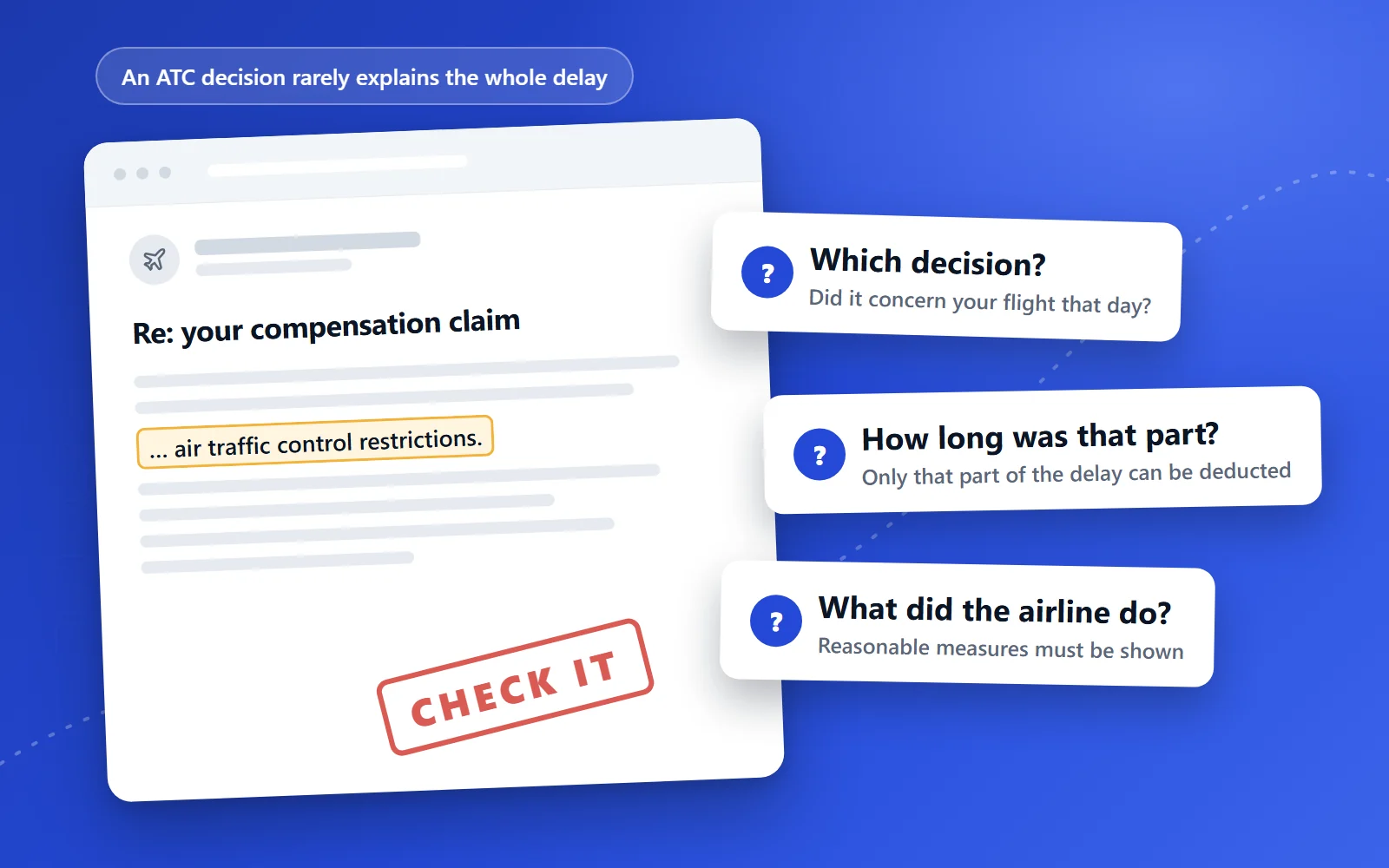
Which decision?
Who took it, when, and for which airspace or airport? A reply that only says ‘ATC’ or ‘traffic restrictions’ cannot be tested.
Did it affect your flight?
Recital 15 concerns a particular aircraft on a particular day. The airline should be able to link the decision to that aircraft and your departure.
How many minutes?
How much is due to the decision determines what can be deducted (C-315/15, paras 50-52).
What did the airline do?
The airline must be able to show what it did to limit the delay, and that more could not reasonably be required (C-549/07, paras 40 and 41).
Was something else involved?
A late inbound aircraft or a gap in the airline's own planning is a different matter from an air traffic control decision. See below.
| The airline writes | What it should be able to show |
|---|---|
| ‘Air traffic control restricted traffic’ | Which decision, from whom, for which airspace and for what period, and that it concerned the flight in question. |
| ‘Congestion in the airspace’ | That this was a decision about this aircraft on that day (recital 15), not a general state of affairs in the airspace. |
| ‘Air traffic controllers' strike’ | That it was controllers or airport staff on strike, not the airline's own staff (C-28/20, paras 42-44). |
| ‘The whole delay was caused by air traffic control’ | How many minutes can be attributed to the decision, and what caused the rest (C-315/15, paras 50-52). |
| ‘We did everything we could’ | Concrete measures, for example re-planning or rebooking, and why further measures could not reasonably be required (C-549/07, para. 41). |
Example: 50 minutes with air traffic control, 3 hours 40 minutes in total
Your scheduled arrival is 14:00 and the door opens at 17:40, so you are 3 hours 40 minutes late. The airline writes that air traffic control restricted traffic. The documents show that air traffic control gave the aircraft a new take-off time 50 minutes later. The remaining 2 hours 50 minutes is because the aircraft arrived late from an earlier flight for reasons unrelated to air traffic control.
If the airline can document the full 50 minutes and show that it took reasonable measures, that part is deducted. That leaves 2 hours 50 minutes, below three hours, and compensation does not arise on that basis (C-315/15, paras 50 and 51).
If the airline can document only 30 minutes, 3 hours 10 minutes remain. That is over the threshold, and the question becomes whether the airline can show anything else. If it has not taken reasonable measures, it may not deduct anything at all (para. 52). The example only shows why the minutes must be specified.
Controllers' strikes and the airline's own staff
A controllers' strike is outside the airline. Recital 14 refers to strikes that are external to the airline's activity, and the Court has said that strikes by air traffic controllers or airport staff may be extraordinary circumstances, because they are beyond the airline's actual control (C-28/20, paras 42 and 43).
The airline's own staff are the opposite. According to the same judgment, a strike called and carried out by the airline's own employees is an internal event, even where trade unions have called for it (para. 44). If the airline writes ‘strike’, the first question is therefore who was on strike. More in strikes and flight compensation.
Air traffic control or the airline's own planning?
An earlier flight can count. If air traffic control affected an earlier flight by the same aircraft, the airline can rely on it, but only if there is a direct causal link with your flight being late (C-74/19, para. 54). See disruption on an earlier flight.
Time reserve is part of planning. When planning, the airline must reasonably take account of the risk of delays and allow some time reserve. If there is none, it cannot be regarded as having taken all reasonable measures (C-294/10, para. 28). There is no general minimum reserve (para. 31), so each case is assessed on its own. See all reasonable measures.
Closed airspace is a different question. See airport and airspace closures.
| Step | On your own | With Airlate |
|---|---|---|
| Interpreting ‘ATC restrictions’ | You find out what the decision was and whether it covered your departure. | Airlate reads the reply against recital 15 and Article 5(3) and assesses what is missing from the documentation. |
| Dividing up the minutes | You try to establish how much of the delay belongs to air traffic control. | Airlate compares the airline's figures with the material you submitted and with independent flight data on the times. |
| Answering when the reason changes | You respond to each new reason the airline puts forward, one at a time. | Once you have submitted the claim and accepted the terms, Airlate handles the correspondence manually, under your authorisation. |
| Taking it further | You decide for yourself whether and how to pursue the matter with an enforcement body or a court. | If we assess that the claim holds, we can take it further, where needed through alternative dispute resolution or court. No outcome can be promised. If we obtain no compensation for you, we charge no service fee, under the Fee Policy. |
What you get to keep
Every company that pursues claims keeps part of the compensation. This is how much of €600 is left for you, according to the companies' own price lists.
What you keep of €600
Of the five companies we compared, you keep the most with Airlate, both when the claim is settled directly and when it goes on to legal process.
| Company | Without legal process | With legal process |
|---|---|---|
| Airlate | €450 | €360 |
| Flyghjälp (Flightright) | €420 | €330 |
| AirAdvisor | €420 | €300 |
| AirHelp | €390 | €300 |
| Skycop | €336 | €300 |
Want to know how it works?
We assess free of charge whether your flight may be covered. If you submit a claim and accept the terms, Airlate handles the claim manually.
Frequently asked questions
No. Recital 15 points to an air traffic management decision about a particular aircraft on a particular day, but the airline must show that the decision existed, that it caused the delay and that reasonable measures were taken (Art. 5(3), C-549/07, paras 40 and 41).
Then only the part the airline can show is due to the extraordinary circumstance is deducted. What remains gives rise to compensation if it is three hours or more (C-315/15, paras 50 and 51).
A controllers' strike is outside the airline and may be an extraordinary circumstance, whereas a strike by the airline's own staff is, as a rule, an internal event (C-28/20, paras 42-44; exception in para. 45). The airline must still show that reasonable measures were taken.
Check your compensation
Free preliminary check. You can change your choice later.
Another flight problemShow all 6 sources
Every factual statement in this article rests on one of the sources below: EU regulations, judgments of the EU Court of Justice and the authorities' own pages.
Sources
- Regulation (EC) No 261/2004 of the European Parliament and of the Council of 11 February 2004 (recitals 14 and 15, Article 5(3)) · EUR-Lex · Regulation · retrieved 2026-10-14
- Judgment in Case C-549/07, Friederike Wallentin-Hermann v Alitalia – Linee Aeree Italiane SpA (Fourth Chamber, 22 December 2008) · Court of Justice of the European Union via EUR-Lex · Case law · retrieved 2026-10-14
- Judgment in Case C-315/15, Marcela Pešková and Jiří Peška v Travel Service a.s. (Third Chamber, 4 May 2017) · Court of Justice of the European Union via EUR-Lex · Case law · retrieved 2026-10-14
- Judgment in Case C-28/20, Airhelp Ltd v Scandinavian Airlines System Denmark – Norway – Sweden (Grand Chamber, 23 March 2021) · Court of Justice of the European Union via EUR-Lex · Case law · retrieved 2026-10-14
- Judgment in Case C-74/19, LE v Transportes Aéreos Portugueses SA (Fourth Chamber, 11 June 2020) · Court of Justice of the European Union via EUR-Lex · Case law · retrieved 2026-10-14
- Judgment in Case C-294/10, Andrejs Eglītis and Edvards Ratnieks v Latvijas Republikas Ekonomikas ministrija (Third Chamber, 12 May 2011) · Court of Justice of the European Union via EUR-Lex · Case law · retrieved 2026-10-14
Related guides
- The airline says ‘extraordinary circumstances’: what does the reply mean?
- Strikes and flight compensation: when can you claim?
- Closed airport and closed airspace: ash clouds, power cuts, refuelling systems, and drones
- "All reasonable measures": the requirement that can defeat a refusal
- "It happened on an earlier flight": when can the airline blame the morning's disruption?
- The airline said no: how to dispute a refusal
- The airline is not responding: what silence means and what you can do