
The airline writes ‘your claim is time-barred’: what does that mean?
At a glance
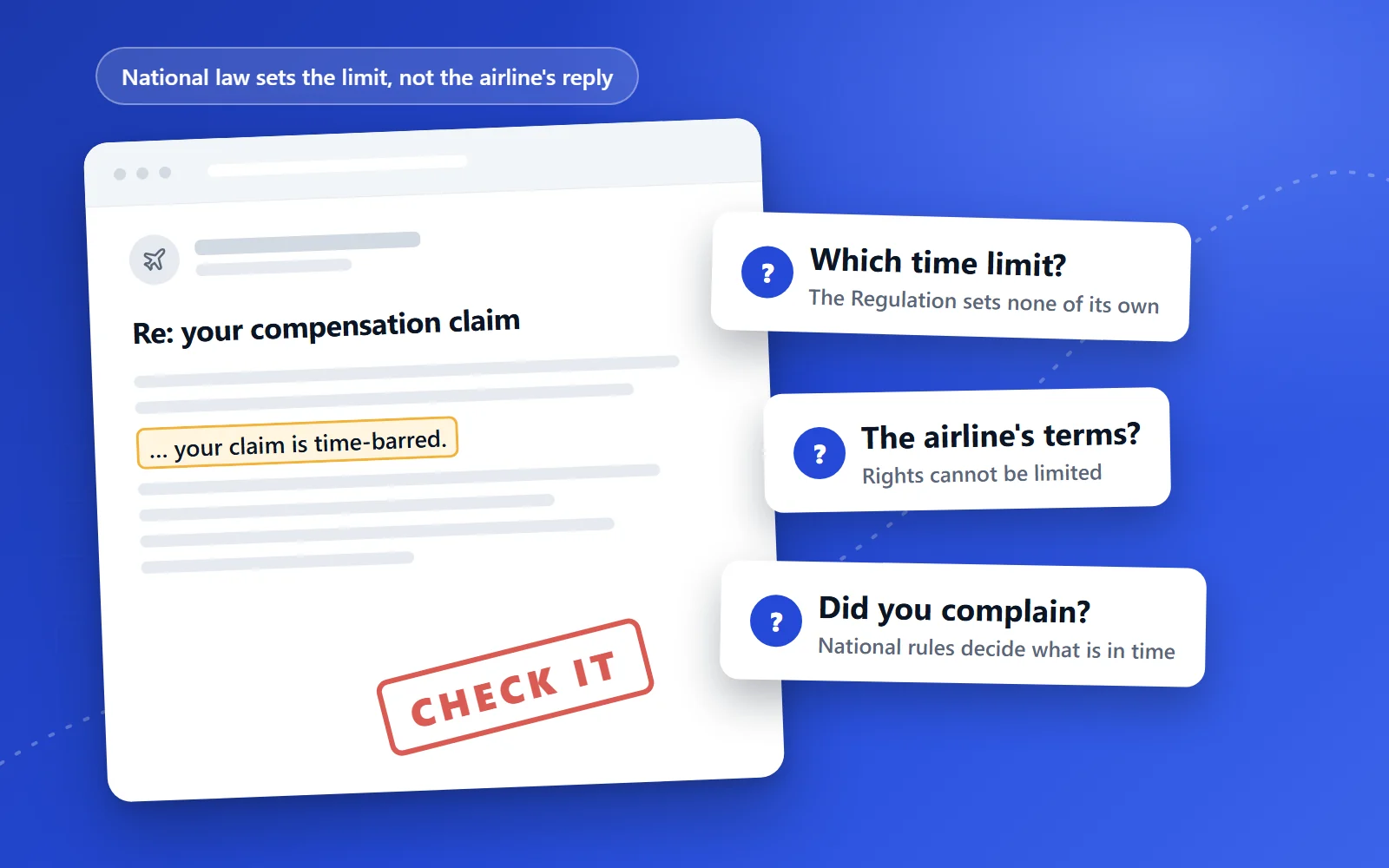
‘Too old’ is a claim that can rest on the airline’s terms, on a limitation period or on a failure to complain in time. The EU regulation sets no time limit, and an airline’s terms may not limit your rights under it (Art. 15(1)). Which deadline the airline means decides the answer.
2 months
after the trip: for a delayed flight, a complaint within that time is always in time under Swedish law (NJA 2018 p. 127)
No EU deadline
the regulation sets no time limit; national rules decide (C-139/11)
23.10.2027
when a nine-month deadline from departure starts to apply (2026/2202)
In this article
Check your compensation
Free preliminary check. You can change your choice later.
Another flight problemFirst: which deadline does the airline mean?
The word ‘old’ can point to three quite different things, governed by different rules. The airline’s own terms may contain a time limit for claims. A limitation period is the statutory time for pursuing a claim. The complaint deadline is the requirement that you notify the airline within a reasonable time. A reply that only says ‘too old’ does not show which one the airline relies on.
EU rules set no time limit. Regulation 261/2004 contains no provision on a limitation period. The Court of Justice has held that the time limit for bringing an action for compensation under Articles 5 and 7 is determined by each Member State’s own rules on the limitation of actions, provided the rules respect the principles of equivalence and effectiveness (C-139/11, operative part and paragraphs 24 and 26).
We cover the national rules in general in how far back you can claim. Here the subject is the reply you have received.
| The airline refers to | What actually applies |
|---|---|
| ‘Our terms say claims must be made within six months.’ | Obligations to passengers under the regulation may not be limited or waived, notably by a restrictive clause in the contract of carriage (Art. 15(1)). Whether a particular clause counts as such a limitation is assessed case by case. |
| ‘That was more than two years ago.’ | The two-year period in the Montreal Convention cannot be regarded as applicable to compensation under Articles 5 and 7 (C-139/11, paragraphs 27–29). National rules decide which period applies instead, and a long delay is no safe harbour. Where Swedish law applies, you must have complained within a reasonable time after the trip, which depends on the circumstances. |
| ‘Your claim is time-barred.’ | The airline should say which country’s rules it means. Where Swedish law applies, a claim becomes time-barred ten years after it arose unless the limitation period is interrupted before then (Limitation Act, section 2). It is not the only deadline: you must also have complained in time. |
| ‘You did not complain in time.’ | Where Swedish law applies and the flight was delayed, you must notify the airline within a reasonable time after the trip. A complaint within two months is always in time (NJA 2018 p. 127). |
| ‘There is now a nine-month deadline.’ | That deadline starts to apply only on 23 October 2027 (Regulation 2026/2202, Art. 3). The regulation has no transitional provision. |
The airline’s terms cannot switch off the regulation
Article 15(1) says that obligations to passengers under the regulation ‘may not be limited or waived, notably by a derogation or restrictive clause in the contract of carriage’. If the airline points to a shorter deadline in its terms, it is something the airline needs to be able to explain against that provision.
Nobody can say in advance how each clause will be assessed. But a clause is not a reason in itself, and a reply that merely quotes the terms has not shown that the claim lacks a basis.
Limitation and complaints under Swedish law
Which country’s rules apply depends on the case, and the airline’s reply does not settle it. Where Swedish law applies, the picture is this.
Limitation. A claim becomes time-barred ten years after it arose unless the limitation period is interrupted before then. Ten years is no safe harbour, though, because the claim can also lapse if you were slow to complain (see below). A written demand from you to the airline can interrupt the limitation period (Limitation Act, sections 2 and 5).
Complaint. Limitation is not the only deadline. The Swedish Supreme Court has held that a passenger who wants compensation under Article 7 for a delayed flight must notify the airline within a reasonable time after the trip. A complaint within two months is always in time. In that case the claim came a little over two years and three months after the flight, and the right had lapsed (NJA 2018 p. 127). The advice is therefore simple: complain within two months.
Nine months does not apply yet
Regulation (EU) 2026/2202 introduces a request for compensation under Article 7 within nine months of the departure date, but it applies only from 23 October 2027. How it affects flights before that date is an open legal question. An airline that refers to nine months today relies on a rule that is not yet in force. See the new EU rules.
Example: ‘our terms say three months’
You landed four hours late in January and sent a written claim in February. In October the airline replies that the claim is too old because the booking terms require a claim within three months.
The airline has referred to a clause, not to a rule in the regulation, and the clause must be explainable against Article 15(1). Where Swedish law applies, you also complained within two months of the trip. That does not make compensation certain, and the airline may have other objections, but the reply does not settle the matter.
| On your own | With Airlate |
|---|---|
| You decide whether ‘too old’ rests on terms, limitation or complaint timing. | We read the reply and go through which reference the airline actually makes. |
| You work out which country’s rules may apply. | We assess that question in your case. |
| You answer the airline and follow up. | Once you have accepted the terms, Airlate handles the contact with the airline. |
Why it pays to let Airlate test the reply
We know the rules. We test the airline’s wording against the rules.
We take the hassle. Airlate handles the claim manually after submission and deals with the airline under your power of attorney.
We do not give up at the first hurdle. If we assess that the claim has reasonable prospects, we can pursue it further, where necessary through supervisory bodies, alternative dispute resolution or the courts. No outcome can be promised. If we obtain no compensation for you, we charge no service fee, under the Fee Policy.
You can go to the Swedish National Board for Consumer Disputes (ARN) or to court yourself, but the route we recommend is to let a representative test the reply. Keep the airline’s reply in its original form. If the airline does not answer at all, read when the airline does not respond.
What you get to keep
Every company that pursues claims keeps part of the compensation. This is how much of €600 is left for you, according to the companies' own price lists.
What you keep of €600
Of the five companies we compared, you keep the most with Airlate, both when the claim is settled directly and when it goes on to legal process.
| Company | Without legal process | With legal process |
|---|---|---|
| Airlate | €450 | €360 |
| Flyghjälp (Flightright) | €420 | €330 |
| AirAdvisor | €420 | €300 |
| AirHelp | €390 | €300 |
| Skycop | €336 | €300 |
Want to know how it works?
We assess free of charge whether your flight may be covered. If you submit a claim and accept the terms, Airlate handles the claim manually.
Frequently asked questions
Obligations under the regulation may not be limited or waived by a restrictive clause in the contract of carriage (Art. 15(1)). Whether a particular clause counts as such a limitation depends on the clause and the case.
No. The Court of Justice has held that the two-year period cannot be regarded as applicable to actions brought on the basis of, among others, Articles 5 and 7 (C-139/11). National rules decide instead.
Where Swedish law applies and the flight was delayed, a complaint within two months of the trip is always in time (NJA 2018 p. 127). Send the claim as soon as you can, and keep the booking, boarding passes and the airline’s messages.
Check your compensation
Free preliminary check. You can change your choice later.
Another flight problemShow all 5 sources
Every factual statement in this article rests on one of the sources below: EU regulations, judgments of the EU Court of Justice and the authorities' own pages.
Sources
- Judgment in Case C-139/11, Joan Cuadrench Moré v Koninklijke Luchtvaart Maatschappij NV (Third Chamber, 22 November 2012) · EUR-Lex / Court of Justice of the European Union · Case law · retrieved 2026-10-15
- Regulation (EC) No 261/2004 of the European Parliament and of the Council, Article 15 · EUR-Lex · Regulation · retrieved 2026-10-15
- NJA 2018 p. 127 ("Flyget till Antalya"), judgment of 15 March 2018 in case T 2659-17 · Supreme Court of Sweden (Högsta domstolen), reproduced on lagen.nu from rattspraxis.etjanst.domstol.se · Case law · retrieved 2026-10-06
- Preskriptionslag (1981:130) (Swedish Limitation Act), sections 2 and 5 · Sveriges riksdag (Swedish Code of Statutes) · Other official · retrieved 2026-10-06
- Regulation (EU) 2026/2202 of the European Parliament and of the Council of 16 September 2026 amending Regulation (EC) No 261/2004 and Council Regulation (EC) No 2027/97 (OJ L, 2.10.2026) · EUR-Lex (Official Journal of the European Union) · Regulation · retrieved 2026-10-15
Related guides
- EU261: the regulation explained
- Delayed flight: your rights
- How far back can you claim flight compensation?
- The airline is not responding: what silence means and what you can do
- The airline said no: how to dispute a refusal
- New EU flight delay rules: what changes from 23 October 2027
- The airline says ‘extraordinary circumstances’: what does the reply mean?