
The airline says ‘the delay was less than three hours’: is that right?
At a glance
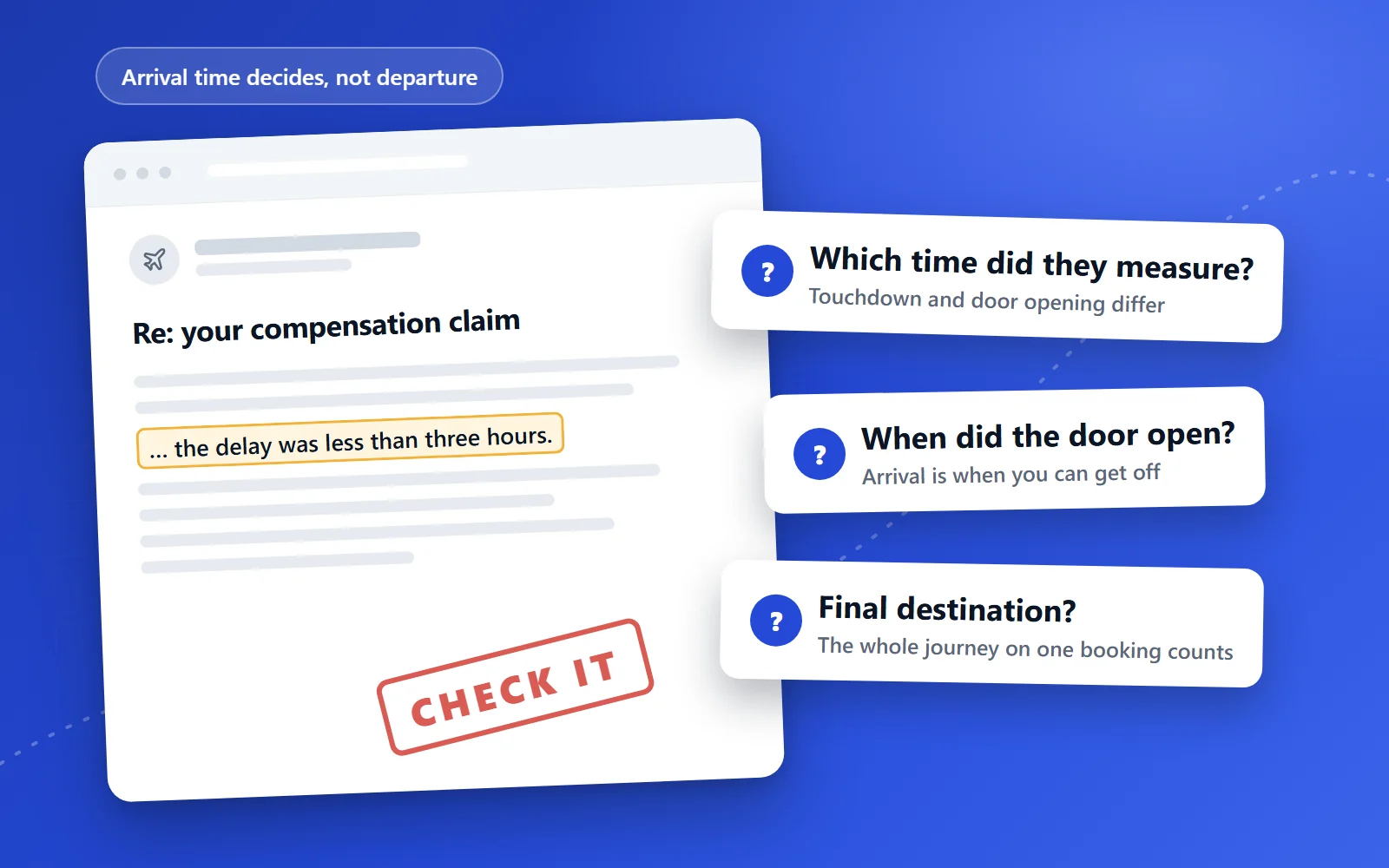
A reply saying the delay was ‘less than three hours’ is a claim about a point in time. What counts is when you reached your final destination, and according to the Court of Justice that is when at least one door opens and passengers may leave the aircraft. The airline's figure may rest on an earlier moment.
3 hours
after scheduled arrival at the final destination is the threshold for compensation (C-402/07, para. 61)
The door
arrival time is when at least one door opens and passengers may leave the aircraft (C-452/13)
Whole journey
on one booking is measured against the last flight's scheduled arrival (C-11/11, para. 35)
In this article
Check your compensation
Free preliminary check. You can change your choice later.
Another flight problemWhat counts, and where the airline's figure can differ
How delay is calculated in general is covered in how flight delay is calculated. Here the focus is the reply you have received.
Arrival decides, not departure. You may be entitled to compensation when you reach your final destination three hours or more after the scheduled arrival time (C-402/07, para. 61). A late departure that is made up in the air does not count.
Arrival is the door, not the touchdown. The Regulation does not define the term, but the Court of Justice has held that arrival time is the moment at which at least one of the doors opens, provided that passengers are allowed to leave the aircraft (C-452/13, para. 25). The Court noted that the passengers' situation does not change significantly when the wheels touch the runway or when the aircraft reaches its parking position, because they are still subject to restrictions on board (paras 23 and 24).
The airline's own timing is not decisive. In the Germanwings case it was precisely the airline that argued the touchdown time should apply (para. 9). The Court also rejected the idea that the parties can fix the moment themselves (para. 18).
| Moment | What it tells you | Counts for compensation? |
|---|---|---|
| Scheduled departure | The time on the ticket. The starting point for a departure delay. | No. A departure delay only decides the right to care and assistance (Article 6), not compensation (C-11/11, paras 36 and 37). |
| Actual departure | When the aircraft leaves the gate or takes off. | Not in itself. A late departure says nothing about how late you arrived. |
| Touchdown | The wheels touch the runway. | No. The Court rejected that moment (C-452/13, para. 23). |
| At the gate | The aircraft is at its parking position with the brakes on. | Not today. Same reasoning (C-452/13, para. 23). Changes from 23 October 2027, see the box below. |
| Door opens | At least one door opens and passengers may leave the aircraft. | Yes. This is the arrival time according to the Court of Justice (C-452/13, para. 25). |
Example: thirteen minutes that change the outcome
Your scheduled arrival is 14.00. The aircraft touches down at 16.55, 2 hours 55 minutes behind schedule. The door opens at 17.08, 3 hours 8 minutes behind. The airline replies that the delay was under three hours, which is correct if you count from touchdown.
Counted as the Court of Justice did in the Germanwings case, from the door opening, the delay is more than three hours. In that case the figures were 2 hours 58 minutes at touchdown and 3 hours 3 minutes at the parking position, with the doors opened shortly afterwards (C-452/13, paras 8 and 9). That does not mean compensation is certain in your case, since, among other things, the airline may invoke extraordinary circumstances, but the reply does not settle the matter.
Is the airline measuring against the right destination?
The final destination counts. If you had several flights on the same booking, it is the delay at the final destination that matters, meaning where your last flight goes (C-11/11, para. 35, and Article 2(h)). An airline that measures the delay on the first leg can therefore arrive at a different figure from the one that applies to the whole journey.
The same booking is the key. Flights on a single booking form a whole (C-537/17, paras 18 and 19). How this works when tickets were bought separately is covered in separate tickets and a missed connection.
A 50% reduction is a separate question. For some long flights compensation may be reduced by half if the arrival is less than four hours late (C-402/07, para. 63). That affects the amount, not whether a right exists.
New definition of arrival time from 23 October 2027
This describes the rules that apply up to and including 22 October 2027. From 23 October 2027, Regulation (EU) 2026/2202 applies. Under the new definition, arrival time is when the aircraft reaches the arrival stand and the parking brakes are set, not when the door opens. The threshold is then a delay exceeding three hours.
What makes a figure possible to test
Which moment does the figure refer to? A reply that merely states ‘2 hours 50 minutes’ without saying whether it means touchdown, parking position or door opening cannot be tested. That is the first thing to clarify.
Evidence from more than one place. Your own papers, such as boarding passes, the booking confirmation and messages from the airline, can be supplemented with independent flight data on actual times.
Extraordinary circumstances are a separate question. Even if the delay is three hours or more, the airline may show that it was caused by such circumstances (Art. 5(3), C-402/07, para. 69). That is assessed separately, see when the airline cites extraordinary circumstances.
What Airlate does with a reply close to the threshold
- We check the exact arrival time. We compare the airline's figure with independent flight data and the material you submitted, and look at which moment the figure refers to.
- We know the case law. We know what the Court of Justice has said about arrival time, final destination and booking, and we assess your flight on its own, free of charge.
- We handle the correspondence. Once you have submitted the claim and accepted the terms, Airlate deals with the airline, manually and under your authorisation.
- We do not give up at the first hurdle. If we assess that the claim has reasonable prospects, we can take it further, where needed through an enforcement body, alternative dispute resolution or court. No outcome can be promised. If we obtain no compensation for you, we charge no service fee, under the Fee Policy.
What you get to keep
Every company that pursues claims keeps part of the compensation. This is how much of €600 is left for you, according to the companies' own price lists.
What you keep of €600
Of the five companies we compared, you keep the most with Airlate, both when the claim is settled directly and when it goes on to legal process.
| Company | Without legal process | With legal process |
|---|---|---|
| Airlate | €450 | €360 |
| Flyghjälp (Flightright) | €420 | €330 |
| AirAdvisor | €420 | €300 |
| AirHelp | €390 | €300 |
| Skycop | €336 | €300 |
Want to know how it works?
We assess free of charge whether your flight may be covered. If you submit a claim and accept the terms, Airlate handles the claim manually.
Common questions
No. The Court of Justice has held that arrival time is when at least one door opens and passengers may leave the aircraft (C-452/13). Touchdown and arrival at the parking position were rejected.
Then it is the arrival at the final destination that counts (C-11/11, para. 35). A short delay on the first flight can mean a long delay where you are actually going.
Compensation under Article 7 can come into question only at three hours or more (C-402/07, para. 61). But if the airline's figure rests on the wrong moment, the real delay may be over the threshold.
Check your compensation
Free preliminary check. You can change your choice later.
Another flight problemShow all 6 sources
Every factual statement in this article rests on one of the sources below: EU regulations, judgments of the EU Court of Justice and the authorities' own pages.
Sources
- Judgment in Case C-452/13, Germanwings GmbH v Ronny Henning (Ninth Chamber, 4 September 2014) · Court of Justice via EUR-Lex · Case law · retrieved 2026-10-14
- Judgment in Joined Cases C-402/07 and C-432/07, Sturgeon and Others v Condor Flugdienst and Böck and Lepuschitz v Air France (Fourth Chamber, 19 November 2009) · Court of Justice via EUR-Lex · Case law · retrieved 2026-10-14
- Judgment in Case C-11/11, Air France SA v Heinz-Gerke and Luz-Tereza Folkerts (Grand Chamber, 26 February 2013) · Court of Justice via EUR-Lex · Case law · retrieved 2026-10-14
- Judgment in Case C-537/17, Claudia Wegener v Royal Air Maroc SA (Eighth Chamber, 31 May 2018) · Court of Justice via EUR-Lex · Case law · retrieved 2026-10-14
- Regulation (EC) No 261/2004 of the European Parliament and of the Council of 11 February 2004 (Articles 2(h), 5(3) and 7) · EUR-Lex · Regulation · retrieved 2026-10-14
- Regulation (EU) 2026/2202 of the European Parliament and of the Council of 16 September 2026 amending Regulation (EC) No 261/2004 and Council Regulation (EC) No 2027/97 (OJ L, 2.10.2026) · EUR-Lex (Official Journal of the European Union) · Regulation · retrieved 2026-10-06
Related guides
- How flight delay is calculated: arrival time is what counts
- Separate tickets: who is liable when you miss your own connection?
- The airline said no: how to dispute a refusal
- The airline says ‘extraordinary circumstances’: what does the reply mean?
- The airline is not responding: what silence means and what you can do
- How far back can you claim flight compensation?