
The airline says ‘you were informed in good time’: what does the reply mean?
At a glance
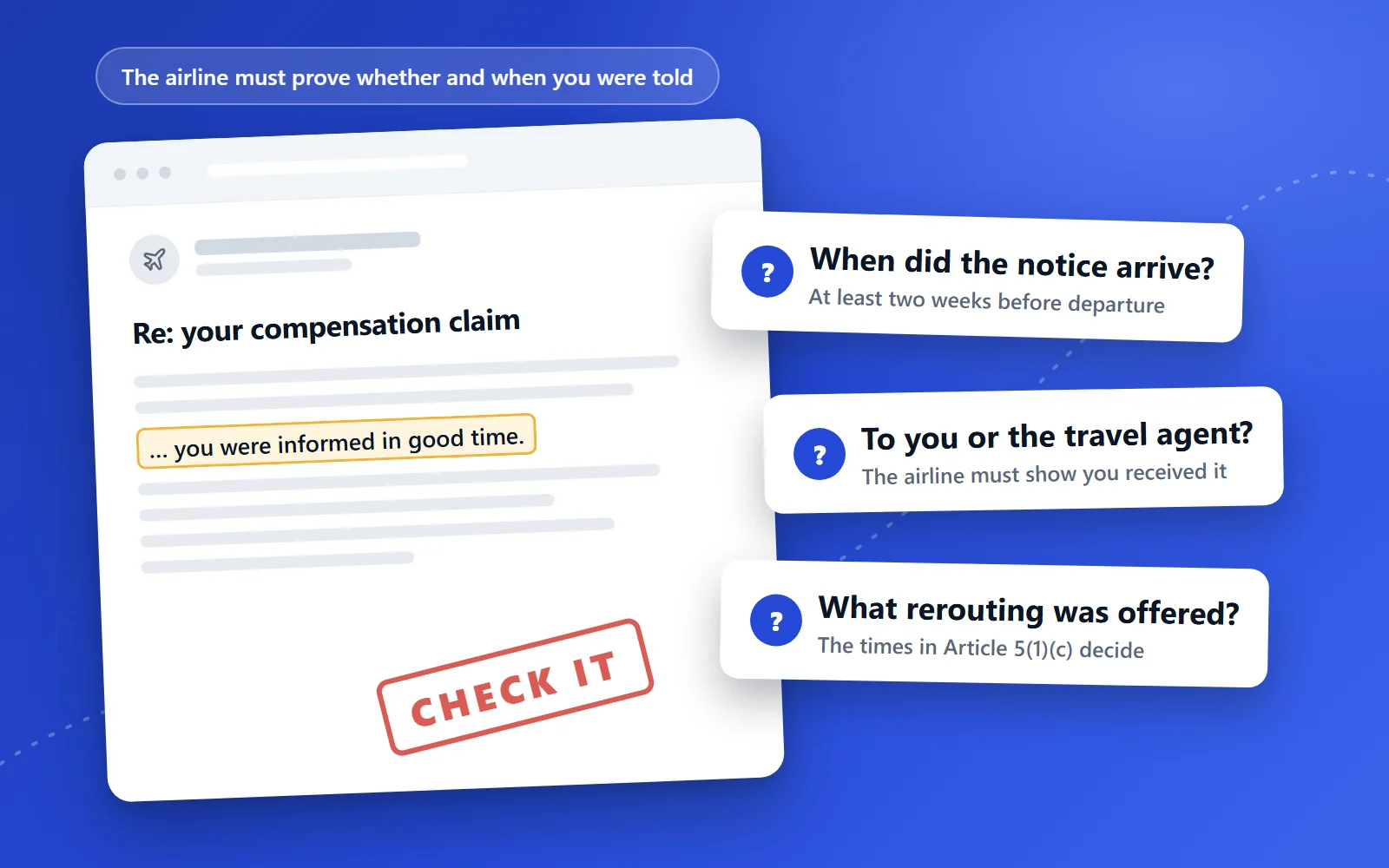
‘You were informed in good time’ is a claim, not a ruling. Under Article 5(4) of Regulation 261/2004 it is the airline that must prove both that you were informed and when. If the proof falls short, compensation may be payable.
14 days
is the main threshold: notice at least two weeks before departure (Art. 5(1)(c)(i))
The airline
must prove both that and when you were informed (Art. 5(4))
€250–600
compensation per passenger under Article 7, by flight distance
In this article
Check your compensation
Free preliminary check. You can change your choice later.
Another flight problemWhat the airline is actually claiming
How a schedule change itself is assessed is covered in our article on flights moved in advance. Here the subject is the reply: has the airline shown that you got notice in time?
Two things must be proved. That you were informed, and when (Article 5(4)). Writing that an email was ‘sent’ is not enough.
This concerns cancellations. The Article 5(1)(c) deadlines apply when a flight is cancelled. A departure time postponed by less than three hours, with no other change, is not a cancellation even if you were told several days ahead (Court of Justice, Case C-395/20, paragraphs 20-23). Bringing a flight forward by more than one hour does count as a cancellation (Joined Cases C-146/20 and others).
The Article 5(1)(c) deadlines, word for word
For a cancelled flight, Article 5(1)(c) gives passengers the right to compensation from the operating air carrier ‘unless’ one of three alternatives applies.
(i) they are informed of the cancellation at least two weeks before the scheduled time of departure.
(ii) they are informed of the cancellation between two weeks and seven days before the scheduled time of departure and are offered re-routing, allowing them to depart no more than two hours before the scheduled time of departure and to reach their final destination less than four hours after the scheduled time of arrival.
(iii) they are informed of the cancellation less than seven days before the scheduled time of departure and are offered re-routing, allowing them to depart no more than one hour before the scheduled time of departure and to reach their final destination less than two hours after the scheduled time of arrival.
The airline may also avoid compensation by proving extraordinary circumstances under Article 5(3). That is a separate test, see when the airline cites extraordinary circumstances.
| When did you get the notice? | What must the airline then show? | If the conditions are not met |
|---|---|---|
| At least two weeks before departure | The airline must be able to prove that you were informed and on which day. | Compensation under Article 7 may be payable, unless extraordinary circumstances are shown. |
| Between two weeks and seven days before | You must also have been offered re-routing departing no more than two hours before and arriving less than four hours after the original times. | The re-routing falls outside the limits or was never offered: compensation may be payable. |
| Less than seven days before | You must also have been offered re-routing departing no more than one hour before and arriving less than two hours after the original times. | The re-routing falls outside the limits or was never offered: compensation may be payable. |
| No notice, or the date cannot be shown | The airline bears the burden of proof (Article 5(4)). | Without proof of notice the airline may have to pay (C-263/20, paragraph 51). |
Did you book through a travel agent or booking site?
It is common for the airline to say it informed you ‘in good time’ by sending the notice to the intermediary. That is not enough in itself. In Case C-302/16 (Krijgsman) the airline had informed an online agency in good time, but the agency passed the notice on only ten days before the flight. The Court held that the airline had to pay compensation where the passenger was not informed at least two weeks before departure, even though the agency had been told in time (paragraphs 25-27).
The exception is express authorisation. If you expressly authorised the intermediary to receive the airline’s notices, and the airline knows it, a presumption of notice under national law may be possible (C-263/20, paragraph 44). That is different from a booking site simply having your email address.
The Court confirmed this in an order where the airline used an email address that was probably generated automatically by the agency. It did not matter that the airline did not know about the intermediary (Case C-307/21, paragraphs 26-27).
Example: ‘we informed the booking site in good time’
You booked through a booking site. The airline cancels the flight and writes in its rejection that the site was told five weeks before departure. The site emails you nine days before. Measured against Article 5(1)(c) you were informed within the second interval, so the question becomes whether you were also offered re-routing within two hours before and four hours after, and whether the airline can prove what you were told and when. The outcome depends on your details, and nothing can be promised.
What to look at in the reply and the email
The date
Which day was the notice sent, and how many days before the scheduled departure was that?
The recipient
Did it go to you, or only to a travel agent or booking site?
The re-routing
Were you offered a new departure, and how far from the original time was it?
The proof
Does the airline attach the message itself with sender and time, or only a statement that it was sent?
| Step | On your own | With Airlate |
|---|---|---|
| Check the date and recipient | You go through your emails, spam folder and the booking site’s messages and count days. | Airlate tests the details you submit against the deadlines and the question of who the notice reached. |
| Compare the re-routing offer | You measure departure and arrival against the limits in Article 5(1)(c) for the right interval. | Airlate makes the comparison against Article 5(1)(c) as part of assessing the claim. |
| Handle the airline’s documents | You request and interpret the airline’s documents and replies. | After you submit and accept the terms, Airlate handles contact with the airline as your representative, manually. |
| Escalate | You choose the route yourself, for example a national complaints body or court, and run the process. | If the assessment holds, Airlate can take the case further, under the terms also through alternative dispute resolution or court. Airlate decides which measures are appropriate, and no outcome can be promised. |
Why it pays to let Airlate pursue the claim
The test is detailed: days, intervals, recipients and proof. We know the rules and assess each case on its own. Once you have submitted your claim and accepted the General Terms, Airlate takes on the hassle with the airline. We do not give up at the first hurdle: if the assessment holds, we take the case further. What Airlate charges is set out in the Fee Policy.
What you get to keep
Every company that pursues claims keeps part of the compensation. This is how much of €600 is left for you, according to the companies' own price lists.
What you keep of €600
Of the five companies we compared, you keep the most with Airlate, both when the claim is settled directly and when it goes on to legal process.
| Company | Without legal process | With legal process |
|---|---|---|
| Airlate | €450 | €360 |
| Flyghjälp (Flightright) | €420 | €330 |
| AirAdvisor | €420 | €300 |
| AirHelp | €390 | €300 |
| Skycop | €336 | €300 |
Want to know how it works?
We assess free of charge whether your flight may be covered. If you submit a claim and accept the terms, Airlate handles the claim manually.
Frequently asked questions
Not necessarily. The airline must prove that you were informed and when (Article 5(4)). If the email went only to an intermediary, that is not enough in itself (C-263/20, paragraph 43).
Then the airline may struggle to show that you were informed. Keep what you have, including the booking confirmation. If the proof is missing, it is for the airline to show it.
No. The deadlines in Article 5(1)(c) concern compensation. The airline must still offer the options in Article 8(1) and inform you of them (C-146/20 and others, paragraphs 99-100).
Check your compensation
Free preliminary check. You can change your choice later.
Another flight problemShow all 6 sources
Every factual statement in this article rests on one of the sources below: EU regulations, judgments of the EU Court of Justice and the authorities' own pages.
Sources
- Regulation (EC) No 261/2004 of the European Parliament and of the Council of 11 February 2004 (Articles 5(1)(c), 5(3), 5(4) and 7(1)) · EUR-Lex · Regulation · retrieved 2026-10-14
- Judgment in Case C-302/16, Krijgsman v Surinaamse Luchtvaart Maatschappij NV (Eighth Chamber, 11 May 2017) · EUR-Lex / Court of Justice · Case law · retrieved 2026-10-14
- Order in Case C-307/21, AB and Others v Ryanair DAC (Eighth Chamber, 27 September 2022, Article 99 of the Rules of Procedure) · EUR-Lex / Court of Justice · Case law · retrieved 2026-10-14
- Judgment in Case C-263/20, Airhelp Limited v Laudamotion GmbH (First Chamber, 21 December 2021) · EUR-Lex / Court of Justice · Case law · retrieved 2026-10-14
- Judgment in Joined Cases C-146/20, C-188/20, C-196/20 and C-270/20 (First Chamber, 21 December 2021) · EUR-Lex / Court of Justice · Case law · retrieved 2026-10-14
- Judgment in Case C-395/20, EP and GM v Corendon Airlines Turistik Hava Taşımacılık A.Ş. (First Chamber, 21 December 2021) · EUR-Lex / Court of Justice · Case law · retrieved 2026-10-14
Related guides
- Cancelled flight: your rights
- EU261: the regulation explained
- Flight brought forward: when does a schedule change count as a cancellation?
- The airline is not responding: what silence means and what you can do
- The airline says ‘extraordinary circumstances’: what does the reply mean?
- The airline said no: how to dispute a refusal