
Snowstorms, ice and de-icing: when can a winter delay give flight compensation?
At a glance
Snow and ice can delay or cancel a flight without ruling out compensation. Weather is only an example in the Regulation, not a ready-made exemption: the airline must show that the weather really prevented your flight and that nothing reasonable could have made a difference.
Recital 14
mentions weather as an example, but weather is not in itself an extraordinary circumstance
2 steps
the airline must show: weather that really prevented the flight, and measures that could not help
Even in bad weather
re-routing or a refund, and care, may apply even when weather is the cause
In this article
Check your compensation
Free preliminary check. You can change your choice later.
Another flight problemWhat the Regulation and the Court of Justice say about weather
Recital 14 of Regulation 261/2004 says that extraordinary circumstances may ‘in particular’ occur in cases of ‘meteorological conditions incompatible with the operation of the flight concerned’. So it is not just any weather, but weather that makes it impossible to operate that particular flight.
The examples are not the answer. The Court of Justice has held that the listed events, weather included, are not in themselves extraordinary circumstances, and that not every circumstance surrounding such an event necessarily justifies exemption (C-549/07, paragraphs 21 and 22).
The second step matters just as much. The airline must also show that it took measures suited to the situation, ones that could reasonably be required in technical and economic terms (C-549/07, paragraph 40), and that it clearly could not have avoided the consequence without intolerable sacrifices (paragraph 41). For how thunderstorms and lightning are assessed, see thunderstorms and lightning, and for the concept as a whole, all reasonable measures.
| Winter problem | May point to an extraordinary circumstance when | May weigh against it when |
|---|---|---|
| A snowstorm that closes the airport | The airport was closed for an external reason and the closure affected your flight (see airport closures). | The airline does not show when the closure applied or that it prevented your departure. |
| A de-icing queue | The queue arose because snowfall overloaded the airport's de-icing and the airline shows what it did to get ahead of it. | The airline cannot show it planned for the queue, or that other flights left while yours stood still. |
| A shortage of de-icing fluid | The shortage lay with the airport or a supplier the airline does not control. | The shortage came from the airline's own ordering or planning. |
| Crew stuck because of snow elsewhere | Snow prevented the crew in a way that could not be solved by reasonable measures. | Reserve crew or another solution was available. |
| Aircraft delayed from an earlier snowy airport | The same aircraft was affected earlier in the day and there is a direct causal link (C-74/19). | It was a different aircraft, or the delay had other causes. |
Weather at the departure airport, or at an earlier stop
Weather where you were due to take off. This is the most common case, and the airline must show how the weather hit your particular flight.
Weather at an earlier stop. The airline may rely on an extraordinary circumstance that affected an earlier flight with the same aircraft, but only if there is a direct causal link with your delay or cancellation (C-74/19, operative part, point 2). See also disruption on an earlier flight.
De-icing and a lack of fluid. We have not found any Court of Justice ruling specifically on de-icing queues or a shortage of de-icing fluid, so we do not claim how they must be assessed. They are judged under the general test above, and national courts have reached different results. What decides it is the cause: what was outside the airline's control and what it could have done.
What the airline should be able to show
- Actual weather data for the right time and place, not a general weather warning.
- Which flights operated from the same airport, since that shows whether the weather really prevented the departure.
- Which measures it took, such as de-icing in good time, extra staff and re-planning.
- Reserve in its planning. The airline must reasonably have allowed for the risk of delay and built in a time buffer, without having to make intolerable sacrifices (C-294/10). There is no general minimum buffer that applies to every airline.
Weather does not remove care and re-routing
The exemption in Article 5(3) applies only to compensation. If the flight is cancelled you can choose between a refund and re-routing, and the airline must provide care while you wait: meals, a hotel and transport when an overnight stay is needed (Articles 5(1)(a) and (b), 8 and 9). That holds even when snow is the cause. Read more about meals, hotel and transport and re-routing at the earliest opportunity.
Example: a January morning at Arlanda
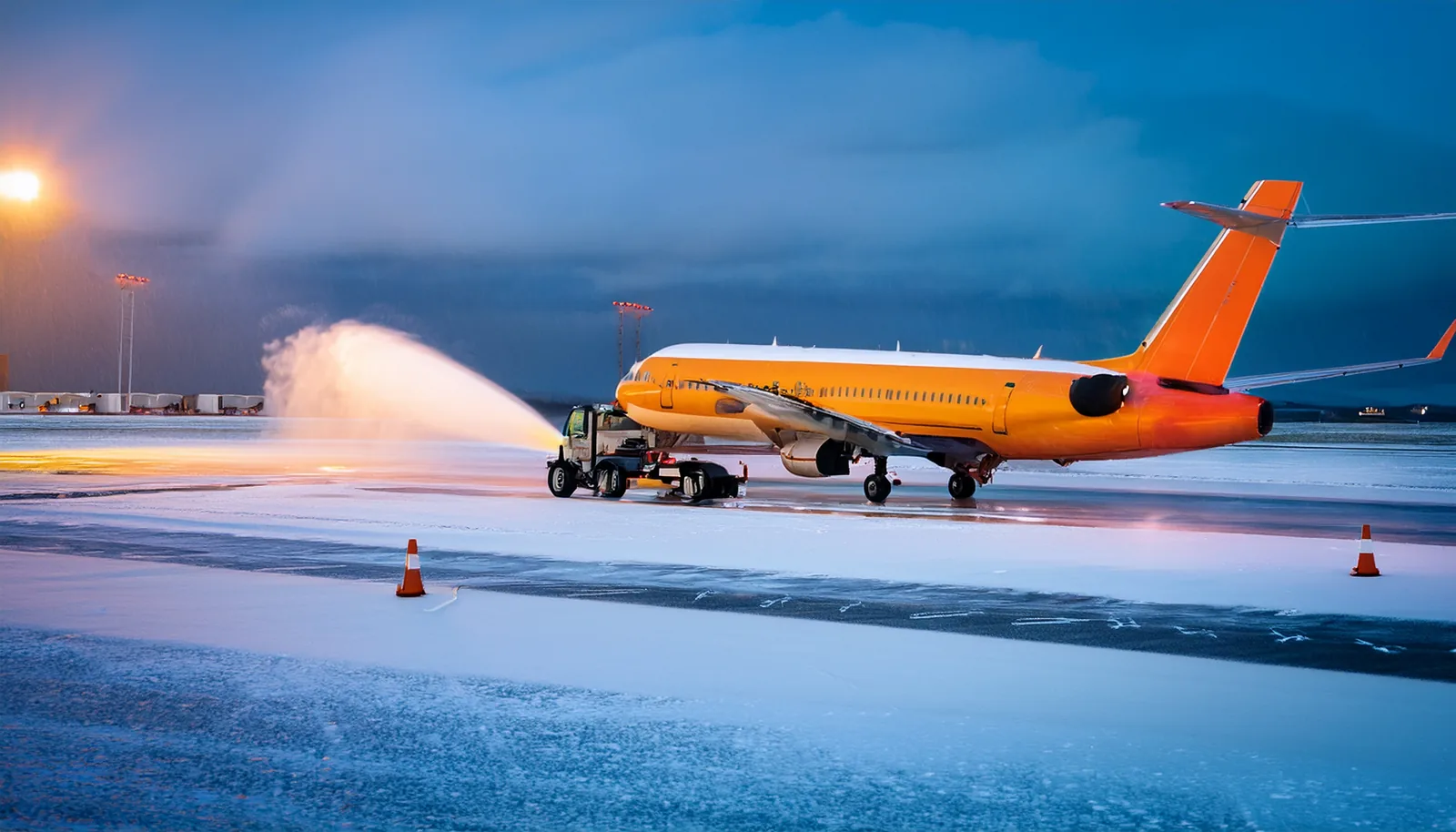
Heavy snow is falling as your morning flight is due to leave. The aircraft waits in a long de-icing queue and takes off almost four hours late. The airline writes ‘weather’. Questions remain that the reply does not answer: did the snow close the runways or was it the queues, did other flights depart in the meantime, and had the airline prepared for de-icing? The answer can differ between flights the same morning, and compensation cannot be promised in advance.
How Airlate helps when weather is the reason
- We check the weather, not just the reply. We set the airline's explanation against the Regulation and Court of Justice case law and assess your flight on its own.
- We handle the contact. Once you have submitted the claim and accepted the terms, Airlate manages the correspondence with the airline manually, under your authorisation.
- We go further when the assessment holds. If the claim has reasonable prospects it can be pursued, where needed through an enforcement body, alternative dispute resolution or court. No outcome can be promised, and Airlate decides which measures are appropriate.
- No compensation, no service fee. If we obtain no compensation for you, we charge no service fee, under the Fee Policy.
What you get to keep
Every company that pursues claims keeps part of the compensation. This is how much of €600 is left for you, according to the companies' own price lists.
What you keep of €600
Of the five companies we compared, you keep the most with Airlate, both when the claim is settled directly and when it goes on to legal process.
| Company | Without legal process | With legal process |
|---|---|---|
| Airlate | €450 | €360 |
| Flyghjälp (Flightright) | €420 | €330 |
| AirAdvisor | €420 | €300 |
| AirHelp | €390 | €300 |
| Skycop | €336 | €300 |
Want to know how it works?
We assess free of charge whether your flight may be covered. If you submit a claim and accept the terms, Airlate handles the claim manually.
Common questions about winter weather and flight compensation
No. Weather is mentioned as an example in recital 14, but is not in itself an extraordinary circumstance (C-549/07, paragraphs 21 and 22). The airline must show that the weather prevented your particular flight and that it could not be avoided by reasonable measures.
You may be entitled to them. Care must be offered even when the cause is extraordinary, on the terms set out in Articles 5, 6 and 9. Keep receipts if you have to pay yourself.
That is a claim tested against the same standard. We have not found any Court of Justice ruling specifically on de-icing queues, so the assessment turns on what was outside the airline's control and what measures it took.
Check your compensation
Free preliminary check. You can change your choice later.
Another flight problemShow all 4 sources
Every factual statement in this article rests on one of the sources below: EU regulations, judgments of the EU Court of Justice and the authorities' own pages.
Sources
- Regulation (EC) No 261/2004 of the European Parliament and of the Council of 11 February 2004 (recitals 14 and 15 and Articles 5(1)(b), 5(1)(c), 5(3), 7(1) and 9) · EUR-Lex · Regulation · retrieved 2026-10-15
- Judgment in Case C-549/07, Friederike Wallentin-Hermann v Alitalia – Linee Aeree Italiane SpA (Fourth Chamber, 22 December 2008) · EUR-Lex / Court of Justice of the EU · Case law · retrieved 2026-10-15
- Judgment in Case C-74/19, LE v Transportes Aéreos Portugueses SA (Fourth Chamber, 11 June 2020) · EUR-Lex / Court of Justice of the EU · Case law · retrieved 2026-10-15
- Judgment in Case C-294/10, Andrejs Eglītis and Edvards Ratnieks v Latvijas Republikas Ekonomikas ministrija (Third Chamber, 12 May 2011) · EUR-Lex / Court of Justice of the EU · Case law · retrieved 2026-10-15
Related guides
- EU261: the regulation explained
- The airline says ‘extraordinary circumstances’: what does the reply mean?
- Thunderstorms and lightning: is compensation paid when your flight is cancelled?
- Closed airport and closed airspace: ash clouds, power cuts, refuelling systems, and drones
- "All reasonable measures": the requirement that can defeat a refusal
- "It happened on an earlier flight": when can the airline blame the morning's disruption?
- Meals, hotel and care during a flight delay
- Re-routing at the earliest opportunity: must the airline put you on another carrier's flight?