
The airline says ‘for safety reasons’: what does it mean?
At a glance
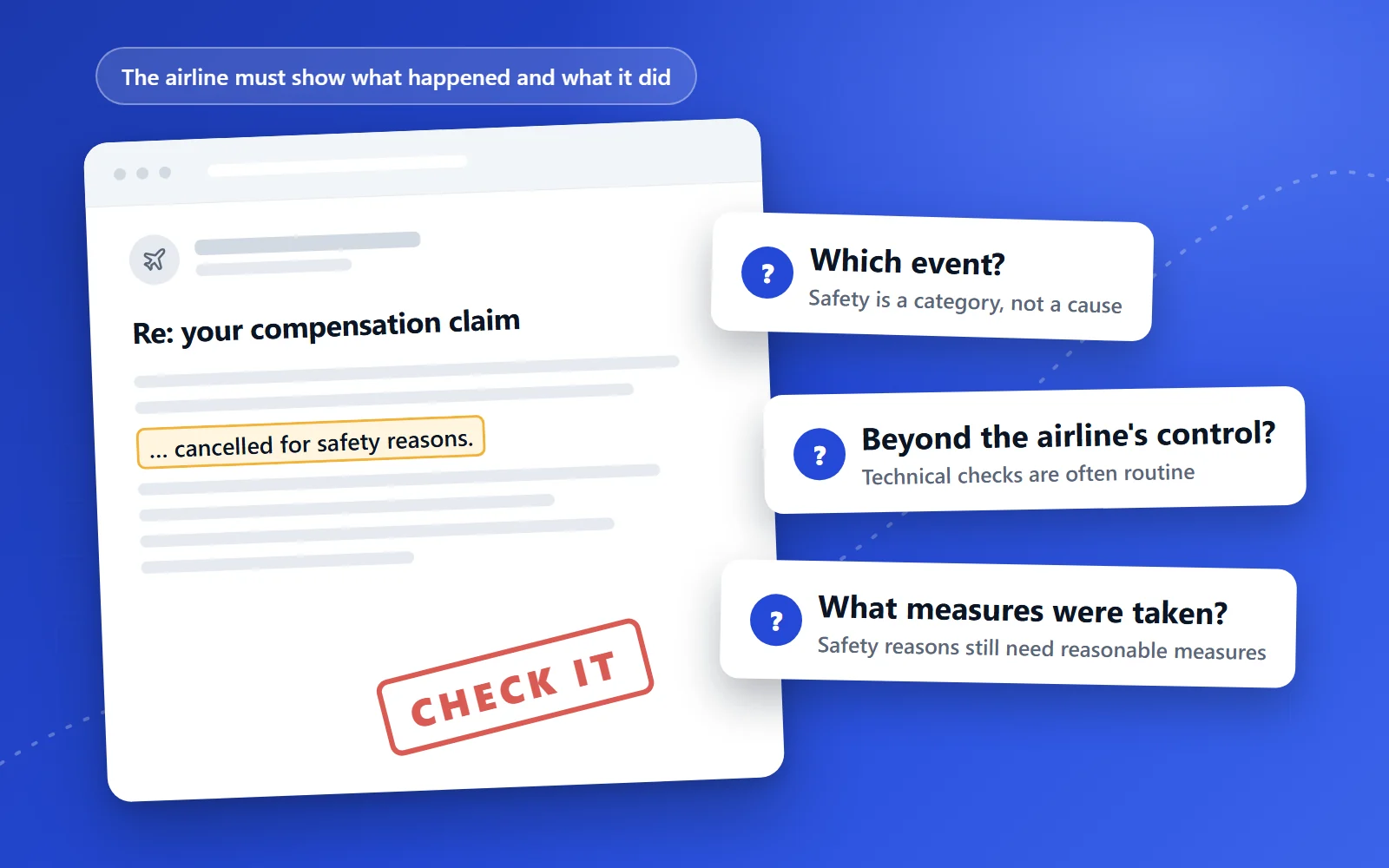
‘For safety reasons’ is a heading, not an explanation. It can be a genuine extraordinary circumstance, such as a bird strike, but also something that belongs to the airline's normal operations, such as an ordinary technical fault. The airline must show which event it was and what measures it took (Article 5(3)).
Recital 14
lists security risks and unexpected flight-safety shortcomings as examples, not automatic exemptions
C-315/15
a bird strike can be extraordinary, but an unnecessary repeat inspection is not
C-156/22
sudden crew illness or death shortly before departure does not count as an extraordinary circumstance
In this article
Check your compensation
Free preliminary check. You can change your choice later.
Another flight problemWhat ‘safety reasons’ actually says
Airlines put safety first, and they should. But the fact that an action was safe says nothing about who bears its cost. The phrase describes why the airline acted, not what happened.
The Regulation mentions security as an example. Recital 14 of Regulation 261/2004 lists security risks and unexpected flight-safety shortcomings among the events that may give rise to extraordinary circumstances. The Court of Justice has said the list is only illustrative: those events are not in themselves extraordinary circumstances, but ones that may give rise to them (C-549/07, paragraphs 21 and 22).
Two things must be shown, and both fall on the airline. First that the event lies outside its normal activity and actual control, and second that the consequences could not have been avoided by measures suited to the situation (C-549/07, operative part point 1 and paragraph 41). The exemption is read strictly (C-549/07, paragraph 20). The wider picture is in when the airline cites extraordinary circumstances.
| Situation | Can be extraordinary when | Is not enough when |
|---|---|---|
| Technical check or aircraft fault | The fault stems from an event that, by its nature or origin, lies outside the airline's normal activity and actual control (C-549/07, operative part point 1). | It is an ordinary technical fault. Parts that fail prematurely belong to the aircraft's functioning (C-315/15, paragraph 23), and meeting the maintenance minimums does not in itself prove all reasonable measures were taken (C-549/07, operative part point 3). |
| Bird strike and the check afterwards | The collision counts as extraordinary, even if the aircraft was not damaged (C-315/15, paragraphs 24 and 25). | The airline had a check repeated that an authorised expert had already carried out (C-315/15, paragraph 35), or cannot show which bird-prevention measures were taken for your flight (C-315/15, paragraph 47). |
| Security threat at the airport | There is no judgment on airport security threats in general. Recital 14 mentions security risks as an example, and in the individual case the airline can point to a concrete event outside its control that hit your flight (Article 5(3)). | The airline just writes the word. The list in recital 14 is not in itself an exemption (C-549/07, paragraph 22), and the airline must show the event and its measures (Article 5(3)). |
| Weather | Recital 14 mentions weather that makes the flight impossible. That is a general principle, not a case: the airline must show how the weather actually affected your flight (Article 5(3)). | The airline mentions weather in general terms. The list in recital 14 is illustrative, not a circumstance in itself (C-549/07, paragraph 22). |
| Passenger incident | Disruptive behaviour led the captain to divert the flight to put the passenger off (C-74/19, operative part point 1). | The airline contributed to the behaviour or did not act on warning signs (C-74/19, paragraphs 45 and 47). |
| Drones near the airport | We have found no judgment on drones. The assessment follows other external events: the airline must show the event and its link to your flight. | The airline just writes ‘drone’ or ‘safety reasons’ without showing how it hit the flight and what measures it took (Article 5(3)). |
| Crew member who suddenly falls ill | Rarely. The sudden absence of a necessary crew member through illness or death shortly before departure is, per the Court, not an extraordinary circumstance (C-156/22, operative part). | The judgment concerns illness and death. Crew planning and working time are part of normal operations (C-156/22, paragraphs 21 and 22). |
| Fault in the airport's fuel system | A general fault in a system the airport is responsible for (C-308/21, operative part). | The fault arose during refuelling carried out with the airline's own staff (C-308/21, paragraph 22). |
Two things that are often forgotten
Even a genuine extraordinary circumstance is only half the proof. The airline must also show that, with all the staff, equipment and financial means available, it manifestly could not have avoided the consequence without unreasonable sacrifices (C-549/07, paragraph 41). And the right to meals, hotel and transport does not disappear, because Articles 5(1)(b) and 9 apply whatever the cause.
Three situations that are often confused
Bird strike. The judgment cuts both ways. The collision itself is extraordinary, but the airline must show what preventive measures it could take and actually took (C-315/15, paragraphs 42–47). If it repeats a check an authorised expert has already done, the delay is not extraordinary. More in bird strikes and runway debris.
Disruptive passenger. The judgment concerns a diversion. It gives no general right to rely on every incident on board, and it does not prevent the airline having contributed to the situation itself (C-74/19, paragraphs 45 and 47). An event on an earlier flight with the same aircraft may also count, but only with a direct causal link (C-74/19, operative part point 2). See disruption on an earlier flight.
Crew and technology. ‘Safety reasons’ is sometimes used for a pilot or cabin crew member who could not fly, or for a technical check. Hard limits apply in both cases: crew illness and staff shortages and technical faults cover them. For closed airports and drones, see airport and airspace closures.
Example: ‘for safety reasons’ with no event
Your flight is cancelled. The reply says briefly that it happened ‘for safety reasons’ and that the airline therefore pays no compensation. It does not say whether it was a bird, an inspection, the weather or something else, nor what the airline did to keep the flight in the air. Measured against Article 5(3), the airline has shown neither an event nor the measures it took. That does not mean you have no claim, only that the reply does not settle the matter on its own.
How we pursue your case
You tell us about the flight
You submit the claim, say what the airline replied and accept the terms. The assessment of whether the flight may be covered is free of charge.
We read the wording against the rules
We test ‘safety reasons’ against the Regulation and Court of Justice case law: which event may lie behind it, and what the airline would need to show.
We handle the contact
Airlate handles the claim manually and pursues the airline on your behalf under your authorisation, so you are spared the correspondence.
We take it further when the assessment holds
If we assess that the claim has reasonable prospects, we can pursue it further, where necessary through supervisory authorities, alternative dispute resolution or court. We decide which steps are appropriate, and no outcome can be promised. If you receive no compensation from the airline, no service fee or additional fee is charged, under the Fee Policy.
Next step
Keep the airline's reply in its original form, with sender and date. You can go on to the national enforcement or dispute bodies or to court yourself, but the route we recommend is to let an agent test the reply against the rules. If the airline does not reply at all, read when the airline does not respond.
What you get to keep
Every company that pursues claims keeps part of the compensation. This is how much of €600 is left for you, according to the companies' own price lists.
What you keep of €600
Of the five companies we compared, you keep the most with Airlate, both when the claim is settled directly and when it goes on to legal process.
| Company | Without legal process | With legal process |
|---|---|---|
| Airlate | €450 | €360 |
| Flyghjälp (Flightright) | €420 | €330 |
| AirAdvisor | €420 | €300 |
| AirHelp | €390 | €300 |
| Skycop | €336 | €300 |
Want to know how it works?
We assess free of charge whether your flight may be covered. If you submit a claim and accept the terms, Airlate handles the claim manually.
Frequently asked questions
Not by itself. Recital 14 mentions security risks as examples of events that may give rise to extraordinary circumstances, but those events are not in themselves such circumstances (C-549/07, paragraph 22). The airline must show the concrete event.
It may be why the flight was stopped, but the question remains whether the event lay outside the airline's normal activity and control, and whether the consequences could have been avoided. An ordinary technical fault is rarely extraordinary (C-549/07).
The duty to offer care under Articles 5(1)(b) and 9 applies even when compensation falls away because of extraordinary circumstances. Keep your receipts if the airline does not arrange it.
Check your compensation
Free preliminary check. You can change your choice later.
Another flight problemShow all 6 sources
Every factual statement in this article rests on one of the sources below: EU regulations, judgments of the EU Court of Justice and the authorities' own pages.
Sources
- Regulation (EC) No 261/2004 of the European Parliament and of the Council of 11 February 2004 (recital 14 and Articles 5(1)(b), 5(3) and 9) · EUR-Lex · Regulation · retrieved 2026-10-14
- Judgment in Case C-549/07, Friederike Wallentin-Hermann v Alitalia – Linee Aeree Italiane SpA (Fourth Chamber, 22 December 2008) · EUR-Lex / Court of Justice · Case law · retrieved 2026-10-14
- Judgment in Case C-315/15, Marcela Pešková and Jiří Peška v Travel Service a.s. (Third Chamber, 4 May 2017) · EUR-Lex / Court of Justice · Case law · retrieved 2026-10-14
- Judgment in Case C-74/19, LE v Transportes Aéreos Portugueses SA (Fourth Chamber, 11 June 2020) · EUR-Lex / Court of Justice · Case law · retrieved 2026-10-14
- Judgment in Joined Cases C-156/22 to C-158/22, TAP Portugal v flightright GmbH and Others (Third Chamber, 11 May 2023) · EUR-Lex / Court of Justice · Case law · retrieved 2026-10-14
- Judgment in Case C-308/21, KU, OP and GC v SATA International – Azores Airlines SA (Eighth Chamber, 7 July 2022) · EUR-Lex / Court of Justice · Case law · retrieved 2026-10-14
Related guides
- EU261: the regulation explained
- The airline says ‘extraordinary circumstances’: what does the reply mean?
- The airline said no: how to dispute a refusal
- Technical faults: when does the airline's exception hold?
- "All reasonable measures": the requirement that can defeat a refusal
- Bird strikes and runway debris: extraordinary, but only for the time it actually caused
- Crew illness or death, and how airport staff shortages differ
- Closed airport and closed airspace: ash clouds, power cuts, refuelling systems, and drones