
The airline says ‘you accepted a voucher’: what does it mean?
At a glance
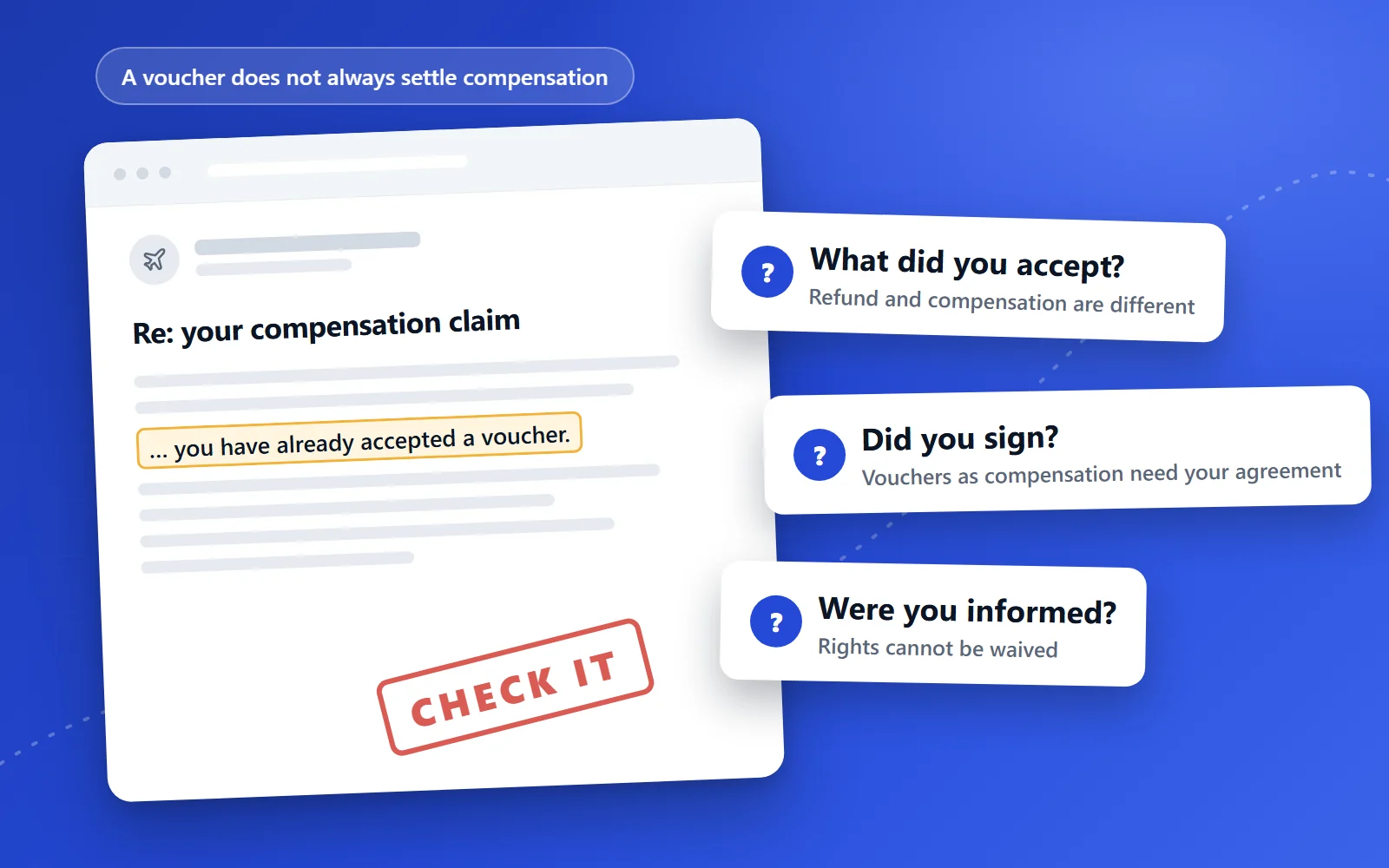
‘You accepted’ does not say what you accepted. A voucher may be a refund of the ticket, compensation or a gesture. Compensation in travel vouchers requires your signed agreement (Article 7(3)), and a lower compensation accepted without proper information does not stop you going further (Article 15(2)).
Article 7(3)
compensation in travel vouchers requires the passenger's signed agreement
C-76/23
consent must be free and informed, and the airline must have given clear and complete information
Article 15(2)
a lower compensation accepted without proper information does not stop you going further
In this article
Check your compensation
Free preliminary check. You can change your choice later.
Another flight problemTwo claims that are easily mixed up
A refund is one thing. If you choose reimbursement on a cancelled flight, the ticket price must be paid back within seven days under Article 8(1)(a). That article refers to Article 7(3) for how the money may be paid.
Compensation is another. It follows from Article 7 and depends on the distance of the flight, not on what the ticket cost. The Regulation deals with the two in separate articles, and we have not found any provision saying that one decides the other.
The same protection applies to both. For a refund and for compensation alike, a voucher may be used only with your signed agreement. Read more about consent in voucher or cash and about the difference between the claims in refund versus compensation.
| What you accepted | What it can mean | What may still apply |
|---|---|---|
| A voucher instead of money when you asked for a refund | The airline may argue the ticket has been refunded. That presupposes free and informed consent (C-76/23, paragraphs 22 and 29–32). | If the consent was not informed, you may be able to claim the money. Compensation under Article 7 is a separate claim. |
| A voucher the airline calls compensation | Article 7(3) requires your signed agreement for compensation to be paid in travel vouchers. | If the agreement is missing, or the information was inadequate, you may be able to claim the compensation in money. Even an accepted lower compensation can be tested (Article 15(2)). |
| A voucher described as a ‘gesture’ or ‘goodwill’ | The Regulation does not use the term. What counts is what the offer says it is for. | Compensation granted under the Regulation may be deducted from further compensation (Article 12(1)). What a gesture is to be set against must be clear from the offer. |
| A voucher with the words ‘settles the matter in full’ | The airline may treat your acceptance as a waiver of more. Article 15(1) says obligations may not be limited or waived. | If you were not properly informed of your rights, you can still go to a court or competent body (Article 15(2)). |
No judgment decides the whole question
C-76/23 concerned reimbursement of the ticket through a web form, not compensation under Article 7. The Court said consent can be given without a signature, but only if the airline fairly gave clear and complete information (paragraphs 32 and 34). We have not found a judgment on whether an accepted voucher closes the compensation claim. It is decided case by case. The rules are also changing: Regulation (EU) 2026/2202 introduces a new Article 8a on vouchers, requiring express consent on a durable medium and all options to be shown clearly. It applies only from 23 October 2027.
Four things to look for in the reply
What exactly did you accept? Clicking ‘redeem’, filling in a form and signing are different things. Keep the email and the form as they looked.
Which claim did it concern? Does it say ‘refund’, ‘compensation’ or nothing at all? Without that, the airline's conclusion is an assertion, not a calculation.
What information did you get? On a cancellation, and on a delay of at least two hours, the airline must give written notice of the rules on compensation and assistance (Article 14(2)). Was money offered as an option, and was it as easy as the voucher?
Does it say the matter is closed? Such a sentence may be a limitation that Article 15(1) does not allow. How it is assessed in your case is for a court or competent body.
Example: ‘you chose the voucher yourself’
Your flight was cancelled. An email gave you two buttons: ‘voucher now’ and ‘money, contact customer service’. You pressed the first. Months later the airline answers your claim by saying you already accepted a voucher. The questions are then what the button covered, whether money was an equally easy option and whether compensation was mentioned at all. If the airline required more steps for money than for the voucher, the Court of Justice says you cannot be regarded as having consented to a voucher as a refund of the ticket (C-76/23, paragraph 32). That does not mean the claim succeeds, but the reply does not settle the matter.
How Airlate handles ‘you have already accepted’
- We read what you actually approved and for which claim, not just the airline's summary.
- We test whether the information and the consent hold up against Articles 7(3), 14(2) and 15 and Court of Justice case law.
- After you submit and accept the terms, Airlate handles the claim manually and deals with the airline as your agent.
- If the assessment holds, we can pursue it further, under the terms also through alternative dispute resolution or court. No outcome can be promised, and if the airline pays nothing no service fee is charged, under the Fee Policy.
What you get to keep
Every company that pursues claims keeps part of the compensation. This is how much of €600 is left for you, according to the companies' own price lists.
What you keep of €600
Of the five companies we compared, you keep the most with Airlate, both when the claim is settled directly and when it goes on to legal process.
| Company | Without legal process | With legal process |
|---|---|---|
| Airlate | €450 | €360 |
| Flyghjälp (Flightright) | €420 | €330 |
| AirAdvisor | €420 | €300 |
| AirHelp | €390 | €300 |
| Skycop | €336 | €300 |
Want to know how it works?
We assess free of charge whether your flight may be covered. If you submit a claim and accept the terms, Airlate handles the claim manually.
Frequently asked questions
It depends on what you approved and what information you received. A claim to compensation under Article 7 can remain even if a refund has been made, and an accepted lower compensation can be tested under Article 15(2).
It can, according to the Court of Justice, if you received clear and complete information and expressly, definitively and unambiguously approved the voucher (C-76/23, paragraph 34). The judgment concerns reimbursement of the ticket.
The judgment places the duty to inform on the airline (C-76/23, paragraphs 30 and 31). Who bears the burden of proof in your case is for the court or body to decide. Keep everything the airline sent.
Check your compensation
Free preliminary check. You can change your choice later.
Another flight problemShow all 3 sources
Every factual statement in this article rests on one of the sources below: EU regulations, judgments of the EU Court of Justice and the authorities' own pages.
Sources
- Regulation (EC) No 261/2004 of the European Parliament and of the Council of 11 February 2004 (recital 20 and Articles 5(1), 7(3), 8(1)(a), 12(1), 14(2) and 15) · EUR-Lex · Regulation · retrieved 2026-10-14
- Judgment in Case C-76/23, Cobult UG v TAP Air Portugal SA (Third Chamber, 21 March 2024) · EUR-Lex / Court of Justice · Case law · retrieved 2026-10-14
- Regulation (EU) 2026/2202 of the European Parliament and of the Council of 16 September 2026 (new Article 8a and Article 3) · EUR-Lex · Regulation · retrieved 2026-10-14
Related guides
- A voucher instead of money: do you have to accept it?
- Refund or compensation: two separate rights, not an either/or
- Can you claim more than the fixed sum? Article 12 and further compensation
- The airline said no: how to dispute a refusal
- The airline says ‘extraordinary circumstances’: what does the reply mean?
- The airline is not responding: what silence means and what you can do