
The airline says ‘it was a technical fault’: what does it mean?
At a glance
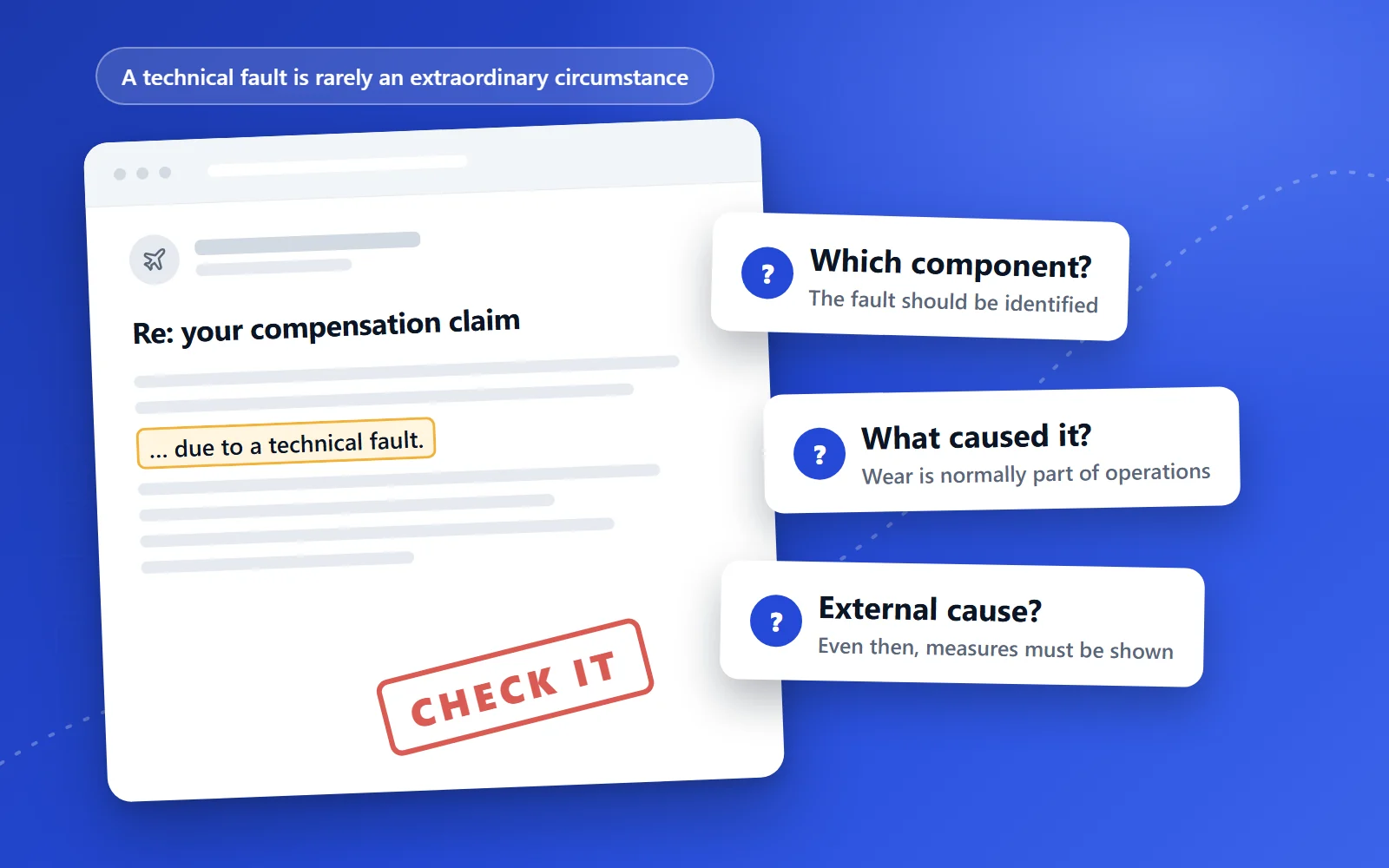
‘A technical fault’ normally belongs to the airline's own operations and is rarely enough as an exemption. It can be extraordinary only when the fault stems from something outside the airline's normal activity and control, such as a hidden manufacturing defect announced by the manufacturer (Article 5(3)). The airline must show it.
C-549/07
a technical problem is not extraordinary unless it stems from events outside the airline's normal activity and actual control
C-257/14
an unexpected fault not detected during routine maintenance is not an extraordinary circumstance
C-501/17
loose debris on the runway that damaged a tyre is extraordinary, but the airline must still show its measures
In this article
Check your compensation
Free preliminary check. You can change your choice later.
Another flight problemWhat ‘technical fault’ actually says
‘Technical fault’ describes a symptom, not a cause. It does not say which part failed, why, or what the airline did about it. And the Regulation places the burden of proof on the airline: it is the airline that must be able to show the exemption applies (Article 5(3)).
The main rule points against the airline. The Court of Justice has held that a technical problem with an aircraft is not an extraordinary circumstance unless it stems from events which, by their nature or origin, are not inherent in the normal exercise of the airline's activity and are beyond its actual control (C-549/07, operative part, point 1). Technical problems are common in operations, and maintenance is part of day-to-day activity (C-549/07, paragraphs 24 and 25). The exemption is interpreted strictly (paragraph 20).
That the fault was unexpected does not help the airline. In C-257/14 the fault was unforeseen, was not due to poor maintenance and had not been detected during routine maintenance. It was still not extraordinary (C-257/14, operative part). Longer walk-through: technical faults: when does the airline's exemption hold?. The wider context is in when the airline cites extraordinary circumstances.
| The airline writes | Normally | Exception |
|---|---|---|
| ‘An unexpected fault in a part’ | Part of normal operations, even when the fault was unforeseen and not visible at maintenance (C-257/14, operative part, and C-549/07, paragraph 25). | Rarely. The fault must stem from an event outside the airline's normal activity and actual control (C-549/07, operative part, point 1). |
| ‘The manufacturer was at fault’ | A fault on the manufacturer's side in an individual part is not enough to refuse compensation (C-257/14, paragraph 45). | The manufacturer or a competent authority has announced that aircraft already in service have a hidden manufacturing defect affecting flight safety. Not enough when the fault concerned only one aircraft and no announcement covers the fleet (C-549/07, paragraph 26, C-257/14, paragraphs 38 and 40). |
| ‘The aircraft was damaged on the ground’ | Mobile steps colliding with the aircraft are part of normal operations (C-394/14, paragraphs 19 and 20, C-501/17, paragraph 30). | Loose debris or another foreign object on the runway that damaged a tyre is extraordinary, but the airline must still show it used all available resources (C-501/17, operative part). |
What the airline needs to be able to substantiate
A reply that says ‘technical fault’ shows none of this. Because the burden of proof is on the airline (Article 5(3)), it needs to be able to substantiate, among other things:
Which part or system was affected.
The cause: wear, an announced hidden manufacturing defect or damage from outside (C-549/07, paragraph 26, C-501/17, operative part).
The inspection and maintenance history of that aircraft. Meeting the minimum requirements is not enough in itself (C-549/07, operative part, point 3).
The measures taken once the fault was found, even with an extraordinary circumstance (C-501/17, operative part).
Example: ‘a technical fault in the hydraulic system’
Your flight is cancelled. The reply says briefly that it was due to a technical fault in the hydraulic system and that the airline therefore pays no compensation. Nothing about the part, the cause or the maintenance.
Measured against Article 5(3), the airline has not shown anything that lifts the fault out of normal operations. Had the reply concerned loose debris that damaged a tyre, the question would differ: the event may be extraordinary, but the airline must show its measures (C-501/17). The reply alone does not decide whether you may be entitled to compensation.
How we handle a technical-fault reply
- We read what the airline writes and does not write: part, cause, maintenance history and measures.
- We test the reply against the Regulation and Court of Justice case law, not against the label ‘technical fault’.
- Airlate handles the claim manually and deals with the airline under your authorisation, so you are spared the correspondence.
- If the assessment holds we can pursue the case further, where necessary through alternative dispute resolution or court. No outcome can be promised. If you receive no compensation from the airline, no service fee is charged, under the Fee Policy.
Next step
Keep the airline's reply in its original form, with sender and date. You can go on to the national enforcement or dispute bodies or to court yourself, but the route we recommend is to let an agent test the reply against the rules. If the airline does not reply at all, read when the airline does not respond.
What you get to keep
Every company that pursues claims keeps part of the compensation. This is how much of €600 is left for you, according to the companies' own price lists.
What you keep of €600
Of the five companies we compared, you keep the most with Airlate, both when the claim is settled directly and when it goes on to legal process.
| Company | Without legal process | With legal process |
|---|---|---|
| Airlate | €450 | €360 |
| Flyghjälp (Flightright) | €420 | €330 |
| AirAdvisor | €420 | €300 |
| AirHelp | €390 | €300 |
| Skycop | €336 | €300 |
Want to know how it works?
We assess free of charge whether your flight may be covered. If you submit a claim and accept the terms, Airlate handles the claim manually.
Frequently asked questions
Normally not. A technical problem is extraordinary only if it stems from events outside the airline's normal activity and actual control (C-549/07, operative part, point 1). The airline must show it.
Not in itself. An unforeseen fault that was not due to poor maintenance and was not detected during routine maintenance is not an extraordinary circumstance (C-257/14, operative part).
No. Compliance with the statutory minimum maintenance requirements is not in itself sufficient to show that all reasonable measures were taken (C-549/07, operative part, point 3).
Check your compensation
Free preliminary check. You can change your choice later.
Another flight problemShow all 5 sources
Every factual statement in this article rests on one of the sources below: EU regulations, judgments of the EU Court of Justice and the authorities' own pages.
Sources
- Regulation (EC) No 261/2004 of the European Parliament and of the Council of 11 February 2004 (recital 14 and Article 5(3)) · EUR-Lex · Regulation · retrieved 2026-10-15
- Judgment in Case C-549/07, Friederike Wallentin-Hermann v Alitalia – Linee Aeree Italiane SpA (Fourth Chamber, 22 December 2008) · EUR-Lex / Court of Justice · Case law · retrieved 2026-10-15
- Judgment in Case C-257/14, Corina van der Lans v Koninklijke Luchtvaart Maatschappij NV (Ninth Chamber, 17 September 2015) · EUR-Lex / Court of Justice · Case law · retrieved 2026-10-15
- Judgment in Case C-501/17, Germanwings GmbH v Wolfgang Pauels (Third Chamber, 4 April 2019) · EUR-Lex / Court of Justice · Case law · retrieved 2026-10-15
- Order in Case C-394/14, Siewert and Others v Condor Flugdienst GmbH (Fifth Chamber, 14 November 2014) · EUR-Lex / Court of Justice · Case law · retrieved 2026-10-15
Related guides
- EU261: the regulation explained
- Technical faults: when does the airline's exception hold?
- The airline says ‘extraordinary circumstances’: what does the reply mean?
- The airline said no: how to dispute a refusal
- "All reasonable measures": the requirement that can defeat a refusal
- Bird strikes and runway debris: extraordinary, but only for the time it actually caused
- The airline says ‘for safety reasons’: what does it mean?
- The airline is not responding: what silence means and what you can do